Structured Light vs Laser vs LiDAR: Which 3D Scanning Technology?
Structured Light vs Laser vs LiDAR: Which 3D Scanning Technology?
Quick verdict: Choose by surface and object size, not by hype. Structured light wins on fine detail, colour and small parts on a bench. Laser wins on dark, glossy and reflective surfaces, on large objects, and out in the field. LiDAR / SLAM is for capturing big spaces quickly at centimetre accuracy — documentation, not inspection. Most industrial work today is done by hybrid laser scanners that combine laser and infrared structured light in one body.
Three technologies dominate 3D scanning, and the marketing around all three is designed to sound universal. It is not. Each one is good at a different combination of object size, surface finish and accuracy, and the fastest way to waste money is to buy for the wrong one.
Here is how each technology actually captures a surface, where it wins, where it fails, and which of our machines belongs to each family.
How each technology captures a surface
Structured light projects a pattern — stripes, fringes or a grid — onto the object and photographs how that pattern distorts across the surface. Software triangulates the distortion into depth. Each shot captures an entire field of view at once, which is why structured light is so strong on fine detail.
Laser scanning projects one or more sharp laser lines and watches them with cameras, triangulating the line into a stream of points as you sweep. Lines can be dense (dozens in parallel) and fast, which is why laser rules on large objects and awkward surfaces.
LiDAR measures the time light takes to return from a surface, or the phase shift in a modulated beam. It needs no pattern and no triangulation, so it works over huge distances — which is exactly why it is used for buildings, sites and vehicles rather than for measuring a die.
Structured light in practice
Where it wins. Fine geometry: sharp edges, small chamfers, intricate mouldings, dental and orthotics work, jewellery, engraved textures. Colour is the other big advantage — a texture camera captures surface appearance along with geometry, which matters for heritage, art and product visualisation. Because a structured light scanner captures a whole field of view per shot, scanning a small object on a turntable is fast and repeatable.
Where it struggles. Shiny, dark and mirror-like surfaces reflect or absorb the pattern, so they either need surface treatment or careful exposure control. Ambient light can interfere, and covering a large object means many small fields of view stitched together, which takes time.
In our range:OptimScan Q12 (four 12.3 MP cameras, dual scan range, monocular-stereo fusion) and AutoScan Inspec2 (one-click desktop, 0.01 mm, full colour) for inspection-grade work; EinScan H2 for faces, bodies and texture-rich objects; and EinScan Libre where colour and texture have to be first class.
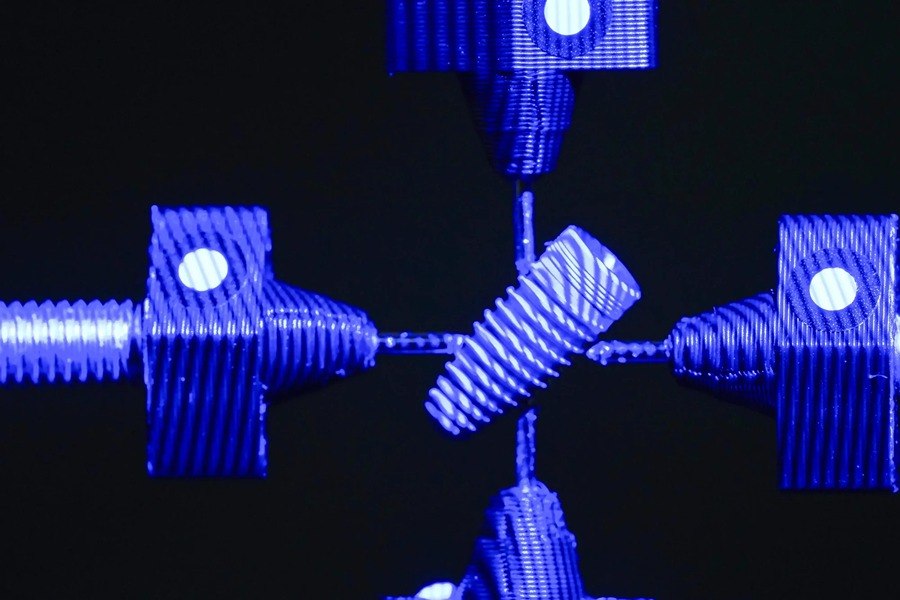
Structured light in close-up: a fringe pattern projected across the surface, read back by the cameras and triangulated into depth.
Laser scanning in practice
Where it wins. Difficult surfaces and large objects. Black rubber, chromed fittings, machined aluminium and cast iron are all routinely scanned without spray, because a laser line is much brighter than the ambient conditions a structured pattern needs. Laser scanners reach into deep pockets, ribs and cavities where a fixed field of view cannot. Add photogrammetry or VPG and the same handheld can hold accuracy across metres of object.
Where it struggles. Very fine surface texture and colour are not a laser’s strength — the data is geometric. Laser also needs a stable way of knowing where the scanner is: features, markers, markers-plus-photogrammetry, or an external tracker.
In our range: handheld and metrology laser scanners including FreeScan Combo+ Wireless (93 laser lines, Wi-Fi 7, ISO 10360-certified accuracy), FreeScan UE Pro2 (3,460,000 points/s), FreeScan UE Nova (2.6 × 2.2 m field of view), FreeScan Trio (98 laser lines, marker-free, 3,010,000 points/s) and FreeScan Omni (standalone scan-to-inspect). The EinScan series — EinScan Trak, EinScan Rigil, EinScan Libre and EinScan H2 — is the professional tier and completes the range for design, heritage and education work, where the tolerance requirement is looser. Tracking systems such as FreeScan Trak Pro2 (0.023 mm, ISO 17025) and FreeScan Trak ProW (8.6 m tracking distance) use an optical tracker instead of markers.
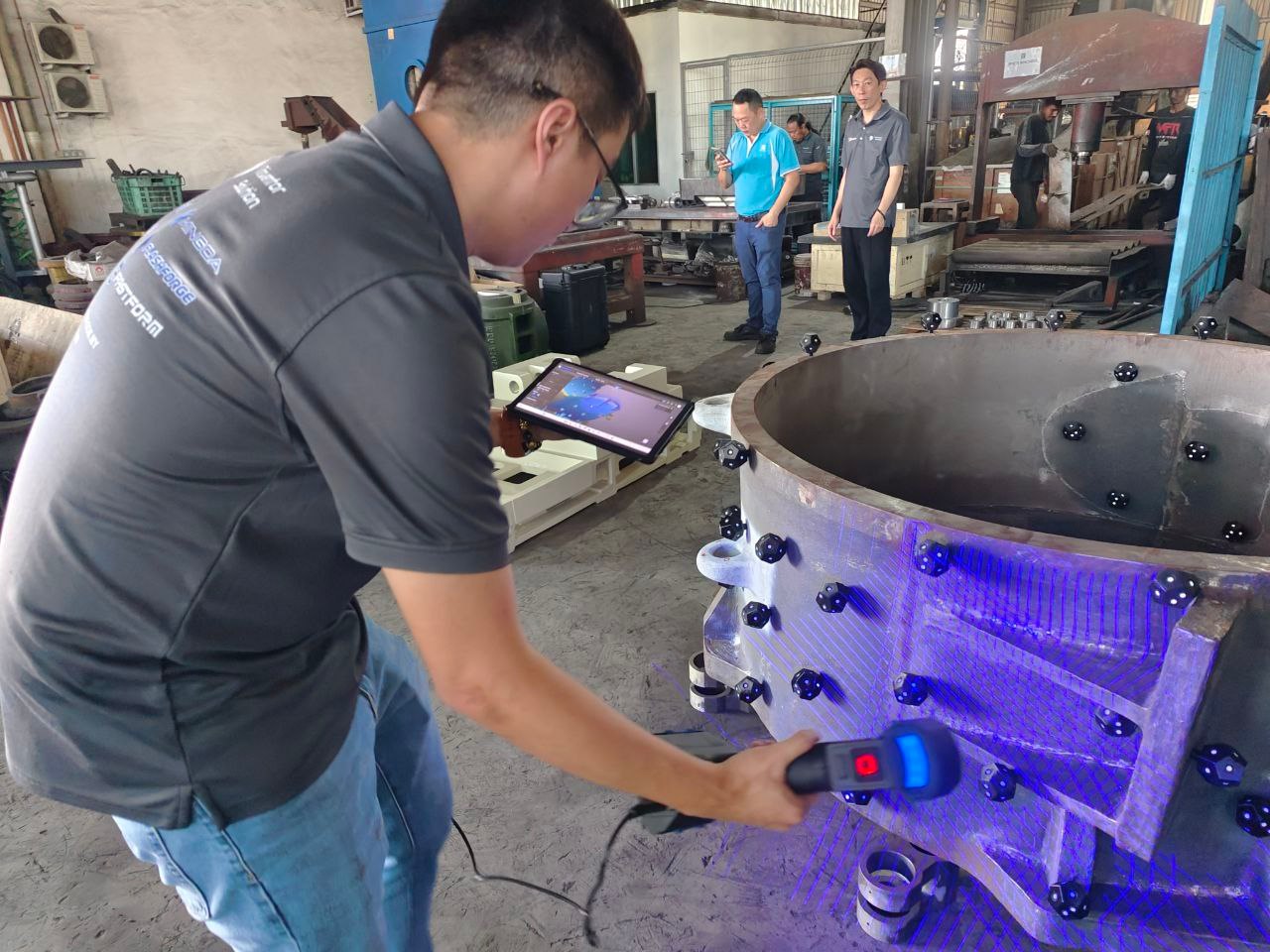
Laser in practice: dense laser lines sweeping a large fabricated ring while the mesh builds live on the tablet, with markers handling the tracking.
LiDAR and SLAM in practice
Where it wins. Speed and scale. A SLAM scanner taken through a factory, a building or a ship captures the whole environment in one continuous walk, no targets needed, no line of sight planning. For as-built documentation, volume estimation, site surveys and digital twins, that is enormously efficient.
Where it fails. Accuracy. Centimetre-level at best, and it degrades with movement, reflective surfaces and featureless corridors. It is not an inspection tool and should never be presented as one. If your output has a tolerance on it, LiDAR is the wrong family.
Where it fits: LiDAR and SLAM scanning is its own family, and it is a family we sell: the SHARE SLAM S20 and the SHARE SLAM S100 series are handheld, self-localising LiDAR scanners built for factory, building, plant and ship documentation. Note the division of labour — this is documentation equipment, not measurement equipment, so no tolerance belongs on its output. Where the need is occasional, we will still say plainly that it is faster and cheaper to have us capture it than to buy a system that sits idle.
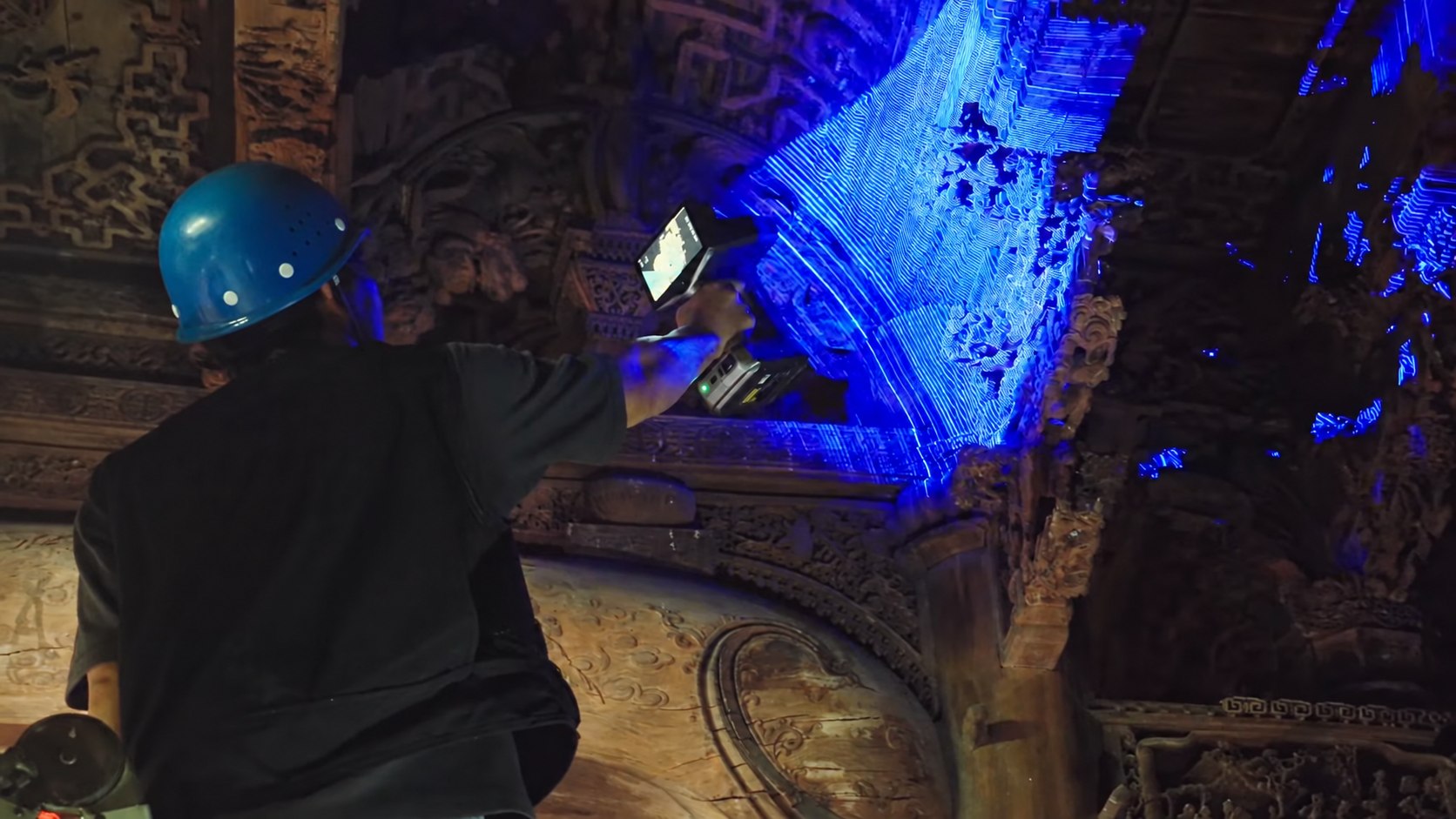
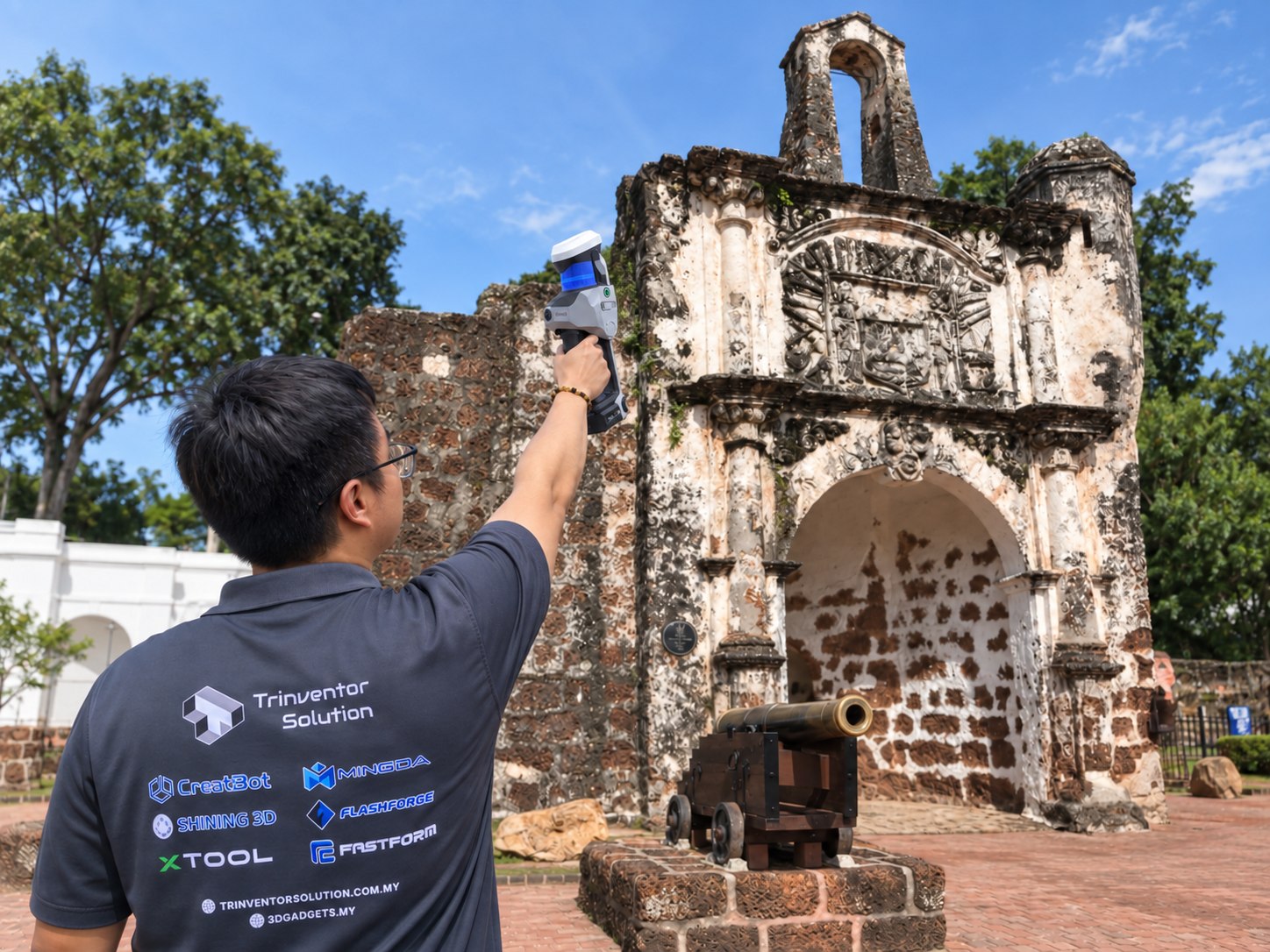
Outdoors and on site: a large, immovable heritage structure captured in place — the scale of subject where mobile scanning is the practical route, and where accuracy expectations have to be set honestly.
Hybrid: why it is becoming the default
The clean separation above is disappearing in the handheld class. A hybrid scanner carries a laser module and an infrared structured-light (VCSEL) module, switching according to the task. Laser lines give speed and handle reflective metal; the IR module gives finer coverage and works in conditions where laser struggles. In practice this means one machine covers dark, glossy and ordinary surfaces without spray and without changing tools.
That is exactly what FreeScan Combo+ Wireless does — 93 laser lines plus an infrared VCSEL module — and what the EinScan Rigil does with a blue laser and IR VCSEL in a tri-mode body. It is no longer one model’s trick: hybrid light is now standard across the handheld range, and what separates the machines is the accuracy class behind it, not the surface handling. If you are buying a handheld in 2026, hybrid is the sensible default.
Side by side
Structured light
Laser
LiDAR / SLAM
Best object size
Small to medium, on a bench
Medium to very large
Rooms, buildings, sites, plant
Fine detail
Excellent
Good
Poor
Black / reflective surfaces
Needs exposure control or treatment
Routinely spray-free
Degrades
Colour / texture
Excellent with a texture camera
Available on some models
Photography overlaid, not measured colour
Accuracy class
0.005 – 0.05 mm
0.02 – 0.05 mm handheld; 0.023 mm tracked
Centimetre level
Tracking
Turntable, features or markers
Features, markers, VPG or external tracker
SLAM — self-localising
Portability
Benchtop mostly
Handheld, often wireless
Handheld or backpack
Typical use
Inspection, dental, jewellery, heritage, QC
Reverse engineering, metrology, field work, large parts
“Structured light can’t scan big parts.” It can — it just takes more setups. The real limit is time and stitching, not physics.
“Laser can’t capture detail.” Modern dense-line laser scanners capture far more detail than the old single-line machines. Where laser still loses is true surface texture, not geometry.
“LiDAR is inspection-grade.” It is not. Anyone selling a SLAM scanner for dimensional inspection is selling you a future argument with your customer.
“More laser lines is always better.” Line count matters alongside field of view, working distance and how the scanner tracks position. A dense scanner that loses its reference produces dense garbage.
How to decide in one conversation
Tell us the object, its surface finish, its size, the accuracy on your drawing and where the work happens. Those five answers map to exactly one technology family — and if the honest answer is “you don’t need a scanner for this, send us the part”, we will say so. Our 3D scanning service handles both on-site and in-house work with mesh, CAD-ready or inspection outputs.