Laser 3D Scanner Malaysia
Quick verdict: for measuring parts, today’s laser 3D scanner is a blue-laser handheld — the FreeScan family — at 0.02 mm class accuracy, and it handles dark, shiny and machined surfaces that stop other technologies. For scanning buildings, plant and sites, “laser scanning” usually means LiDAR (SHARE SLAM). This page explains both, and which machine fits which job in Malaysia.
Two different tools get called a “laser 3D scanner”. One is the handheld blue-laser scanner engineers use to measure parts — the workhorse of reverse engineering, tooling and quality control. The other is the LiDAR / SLAM scanner used to capture buildings, factories and sites as colourised point clouds. Both use laser light; they solve completely different problems.
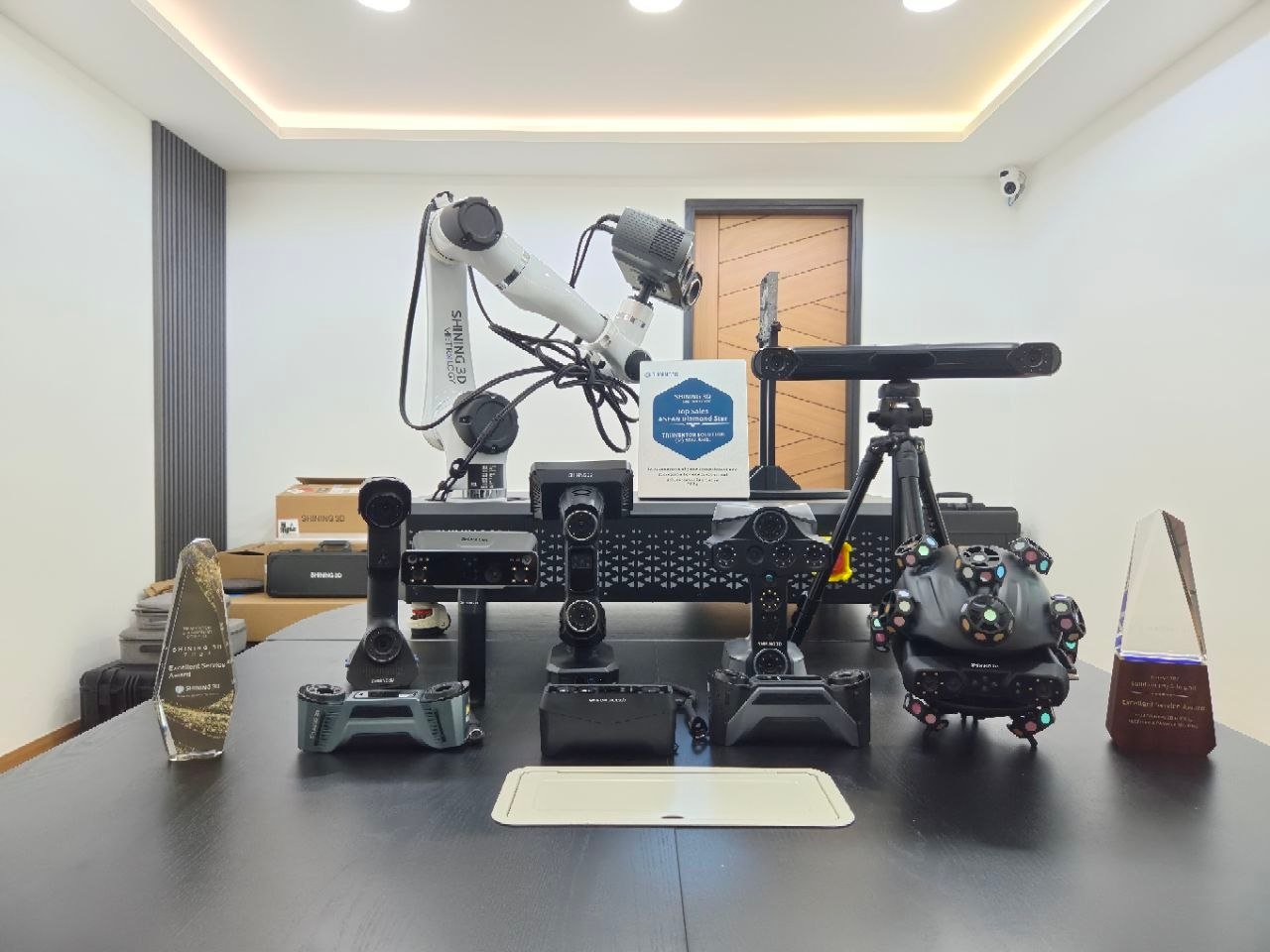
Trinventor Solution supplies and supports both in Malaysia — from handheld metrology scanners and tracked systems to robot-mounted cells and handheld LiDAR — with local demonstrations on your own parts. This page explains what each does, where laser scanning wins, and how to choose.
What a laser 3D scanner does
A handheld laser scanner projects laser lines onto the part; cameras read how the lines deform, and the scanner builds a dense point cloud in real time. The advantages that matter in a workshop:
- It works on real surfaces. Machined metal, dark plastics, shiny and reflective parts — blue-laser light cuts through the surface finishes that make structured light struggle. On most parts, no coating or preparation is needed.
- Single-line mode reaches inside. The narrow single-laser mode captures deep holes, bores and hidden pockets that area-based scanners cannot see — engine blocks, moulds and castings included.
- It is a measuring instrument. Metrology-class models carry 0.02 mm accuracy, and the top of the range is accepted with ISO 10360 testing — so the data can support inspection reports, not just pretty meshes.
- It scales up. Tracked systems and photogrammetry remove the drift that builds up on large parts, so assemblies and full-size components stay accurate.
Laser, structured light or LiDAR — which do you need?
|
Handheld laser
(FreeScan) |
Structured light
(EinScan) |
LiDAR / SLAM
(SHARE SLAM) |
| Best for |
Machined, dark, reflective and mixed-surface parts; inspection and reverse engineering |
Design work, fine detail, colour and texture; people and organic shapes |
Buildings, plant, sites and large areas — documenting spaces |
| Accuracy |
0.02 mm class; ISO 10360-certified on metrology models |
Accuracy-optimised for design work rather than tolerance reports |
Up to 1 cm, with RTK/PPK georeferencing |
| Typical jobs |
First-article and production QC, mould and die, tooling, additive manufacturing |
Product design, heritage, healthcare, education |
As-built surveys, BIM, volume checks and site documentation |
| See |
Metrology laser scanners |
EinScan range |
SHARE SLAM |
If you are unsure what you are looking at: laser scanners measure parts; LiDAR scanners document spaces. If your job is a tolerance, choose laser or structured light; if your job is a building or a site, choose LiDAR.
The laser scanner range we supply
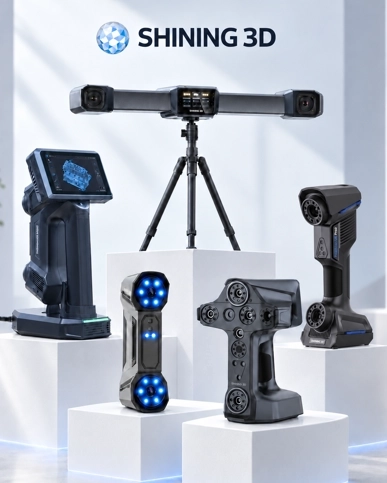
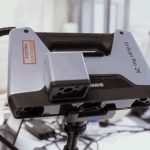
- FreeScan Combo+ Wireless — the cordless hybrid-light metrology handheld: Wi-Fi 7, 93 laser lines with a 25-line detail mode, built-in video photogrammetry, ISO 10360-certified 0.02 mm accuracy. The machine for inspection work that leaves the bench.
- FreeScan UE Pro2 — the lighter metrology handheld for everyday reverse engineering and inspection.
- FreeScan Trak Pro2, Trak ProW and Trak Nova — tracked systems: the tracker follows the scanner, so large assemblies and full-size parts hold accuracy without covering the part in markers.
- FreeScan Omni — standalone scan-to-inspect: capture and check the part on the scanner itself.
- OptimScan Q12 and AutoScan Inspec2 — automated, fixed-position inspection scanners for repeat parts and production lines.
- SHARE SLAM S20 and SHARE SLAM S100 — handheld LiDAR for documenting sites rather than measuring parts.
Also in the range: EinScan Rigil, EinScan Libre and EinScan H2 structured-light scanners for design and detail work; and robot-mounted inspection cells for automated production checks. Not sure which technology you need? The buyer’s guide walks through the three decisions, and the industrial scanner guide matches machines to industries.
What people use laser scanning for
- Reverse engineering and scan-to-CAD — capture a part, get a CAD model; see reverse engineering and scan-to-CAD.
- Inspection and quality control — compare parts to CAD, first-article and production checks; see 3D inspection and metrology.
- Mould, die and tooling work — capture the form, rebuild the tool path.
- Additive manufacturing — qualify printed parts against the design.
- Site and plant documentation — with LiDAR rather than part scanners.
If you only need the data rather than the machine, our 3D scanning service produces it for you — the honest option for one-off parts or to test the workflow before buying.
What does a laser 3D scanner cost in Malaysia?
Laser scanners are priced by accuracy class, field of view, tracking method and the software that turns data into an answer — which is why we quote against your parts rather than publish a number. The scanner cost guide explains the tiers and what changes the figure; exact pricing comes as a quote per configuration.
Demonstrations and local support
We demonstrate in Kuala Lumpur and on customer sites across Malaysia, using your own parts wherever possible — the fastest way to see whether a laser scanner handles your surfaces and tolerance. Every machine ships with installation, hands-on training and local after-sales support, with official warranty cover. Book a demonstration or ask for a quotation.
Frequently asked questions
Is a laser 3D scanner better than a structured-light scanner?
They win different jobs. Laser scanners handle dark, shiny and machined surfaces and reach into deep holes; structured-light scanners capture fine detail, colour and texture beautifully, and suit design work. For inspection and reverse engineering of real workshop parts, laser is usually the right tool.
Will a laser scanner work on dark or reflective parts?
Yes — that is exactly where blue-laser scanning earns its place. Machined aluminium, dark plastics and shiny castings generally scan without spray or coating.
Do laser scanners need markers?
For many parts, no: feature-tracking modes work without markers. Large parts benefit from photogrammetry, and tracked systems use a tracker instead of covering the part in markers.
What accuracy can I expect from a laser 3D scanner?
Metrology-class handhelds hold 0.02 mm class accuracy; the top models are ISO 10360-certified so results can support inspection and reporting. Design-focused machines optimise for speed and detail rather than tolerance reports.
Can I scan large parts or whole assemblies?
Yes. Tracked systems (FreeScan Trak) and photogrammetry remove drift on large work, and for buildings and sites the LiDAR route (SHARE SLAM) captures them as georeferenced point clouds.
Can I see a laser scanner working before buying in Malaysia?
Yes — we run live demonstrations in Kuala Lumpur and on site, and we will scan your own part so you can judge the result first. If you need a result rather than a machine, the scanning service covers that too.
{“@context”:”https://schema.org”,”@type”:”FAQPage”,”mainEntity”:[{“@type”:”Question”,”name”:”Is a laser 3D scanner better than a structured-light scanner?”,”acceptedAnswer”:{“@type”:”Answer”,”text”:”They win different jobs. Laser scanners handle dark, shiny and machined surfaces and reach into deep holes; structured-light scanners capture fine detail, colour and texture beautifully, and suit design work. For inspection and reverse engineering of real workshop parts, laser is usually the right tool.”}},{“@type”:”Question”,”name”:”Will a laser scanner work on dark or reflective parts?”,”acceptedAnswer”:{“@type”:”Answer”,”text”:”Yes — that is exactly where blue-laser scanning earns its place. Machined aluminium, dark plastics and shiny castings generally scan without spray or coating.”}},{“@type”:”Question”,”name”:”Do laser scanners need markers?”,”acceptedAnswer”:{“@type”:”Answer”,”text”:”For many parts, no: feature-tracking modes work without markers. Large parts benefit from photogrammetry, and tracked systems use a tracker instead of covering the part in markers.”}},{“@type”:”Question”,”name”:”What accuracy can I expect from a laser 3D scanner?”,”acceptedAnswer”:{“@type”:”Answer”,”text”:”Metrology-class handhelds hold 0.02 mm class accuracy; the top models are ISO 10360-certified so results can support inspection and reporting. Design-focused machines optimise for speed and detail rather than tolerance reports.”}},{“@type”:”Question”,”name”:”Can I scan large parts or whole assemblies?”,”acceptedAnswer”:{“@type”:”Answer”,”text”:”Yes. Tracked systems (FreeScan Trak) and photogrammetry remove drift on large work, and for buildings and sites the LiDAR route (SHARE SLAM) captures them as georeferenced point clouds.”}},{“@type”:”Question”,”name”:”Can I see a laser scanner working before buying in Malaysia?”,”acceptedAnswer”:{“@type”:”Answer”,”text”:”Yes — we run live demonstrations in Kuala Lumpur and on site, and we will scan your own part so you can judge the result first. If you need a result rather than a machine, the scanning service covers that too.”}}]}
Related: All 3D scanners · Handheld 3D scanners compared · Structured light vs laser vs LiDAR · Scanner costs · Handheld vs desktop vs tracked · Book a demonstration
Looking for the right solution for your application? Our team is here to help. Talk to our 3D solution specialist today.