Powder Bed Fusion 3D Printing: How It Works, Materials, And Applications
Powder Bed Fusion 3D Printing: How It Works, Materials, And Applications
Quick verdict: Powder bed fusion is the additive process that has gone furthest into real production. Laser systems cover stainless and tool steels, aluminium, titanium and cobalt chrome. Electron beam machines own the titanium orthopaedic implant market. Polymer laser sintering produces tough nylon parts with no support structures at all. If your part is complex, made of metal and needed in modest volumes, PBF is the first process to compare against.
Geometry costs almost nothing in a powder bed. Internal channels, lattice structures and organic shapes build for the same effort as a solid block of the same envelope. This guide explains how each layer is spread and fused, what separates laser systems from electron beam machines, which metals and polymers you can run, how parts are finished after the build, and where Malaysian manufacturers are already using PBF in production.
How a powder bed fusion build runs
Powder bed fusion builds a part by fusing powder, layer upon layer, inside a chamber filled with the same material. Each layer is a horizontal cross section of the CAD model. Stack enough of them and the part appears, held in position by the loose powder around it rather than by a fixture or a raft.
Slice the model. The CAD file is sliced into hundreds, sometimes thousands, of horizontal sections, each typically 20 to 50 microns thick.
Fill and heat the chamber. Metal powder is loaded into the build chamber and held just below the melting point of the alloy.
Spread one layer. A recoater blade sweeps a thin, even layer of powder across the build platform.
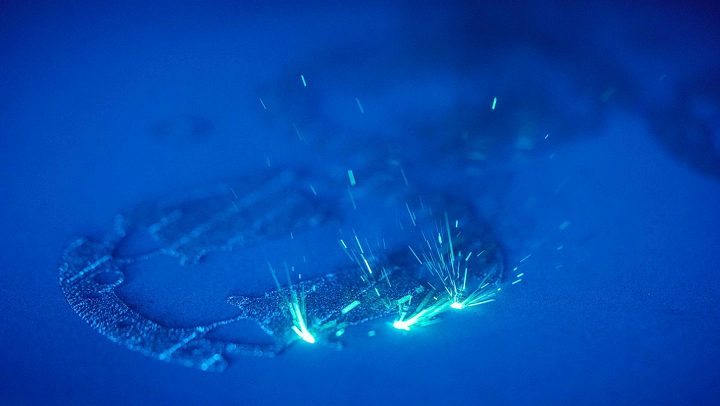
Fuse the cross section. The laser or electron beam traces the pattern for that layer, fusing powder only where the geometry requires it.
Index down and repeat. The platform lowers by exactly one layer thickness, fresh powder is spread, and the next cross section is fused. The cycle repeats until the part is complete.
Cool, break out, finish. The build is left to cool, then the part is lifted out of the powder cake, separated from its supports and sent for post-processing.
All of this happens in a controlled atmosphere: an inert gas for laser systems, a vacuum for electron beam machines. Oxidation is the enemy, because an oxidised melt pool means weak layer bonds and inconsistent properties through the build. Atmosphere control is also why a PBF part holds its properties from the first layer to the last.
Why overhangs survive without a support forest
The loose powder around the part is what makes PBF so free with geometry. In polymer laser sintering, unsintered powder supports overhanging features directly, so a part can be designed without the support structures an FDM printer would need for the same shape.
Metal behaves differently. A metal melt pool has to shed heat quickly, and surrounding powder is a poor conductor, so build preparation software generates support structures automatically to anchor overhanging regions to the build plate or to the layers below. Those supports also act as heat sinks. They are cut away during post-processing, which is one of the practical costs of metal PBF that a machine brochure rarely mentions.
Laser-based powder bed fusion
Most PBF machines melt metal with a laser. The same core process is sold under several names: selective laser melting, direct metal laser sintering and laser metal fusion, usually shortened to SLM, DMLS and LMF. The labels came from a genuine technical difference in the early days, when some systems only partially sintered the powder while others melted it completely. Modern machines reach near-full density either way, so the terms have converged in practice. When you compare supplier specifications, read the laser configuration, the layer thickness range and the material qualification data rather than the acronym.
Laser systems use fibre, disk or CO2 sources, typically from 100 to 1000 watts. Production machines increasingly carry multiple lasers to raise throughput. Galvo mirrors reposition each beam rapidly across the powder bed, so coverage speed does not depend on part geometry. Argon or nitrogen maintains a low-oxygen atmosphere in the chamber, and a gas flow system continuously removes smoke and spatter so the beam always meets clean powder.
The chamber is the part of a laser PBF system that rewards a close look. Powder handling, gas flow, oxygen monitoring and filter management decide whether the machine runs an overnight build unattended or needs an operator standing beside it. Ask any supplier how powder is recovered, sieved and recharged, and how the machine behaves on a build that runs for a full day.
Polymer laser sintering
The same laser layer-by-layer principle applies to polymers, usually under the name selective laser sintering. There is no melt pool to cool, no support structures to remove and no stress relief to schedule. Parts emerge from the powder cake with a matte, slightly grainy surface and are ready for bead blasting, dyeing or assembly. Typical work includes ducting, brackets, jigs and fixtures, low-volume enclosures and functional prototypes that have to survive real use rather than sit on a desk.
Electron beam melting
Electron beam melting (EBM) replaces the laser with a beam of accelerated electrons. A tungsten filament generates the electrons, an accelerating voltage between 60 and 80 kilovolts drives them forward, and magnetic coils focus and steer the beam across the powder bed. Because magnetic deflection needs no moving optics, the beam can be switched between scan strategies very quickly.
The build runs in a high vacuum, which takes oxidation out of the picture altogether and lets reactive metals such as titanium run without a special gas atmosphere. Powder bed temperatures are the bigger difference. An EBM machine runs the bed at roughly 700 to 1000 degrees Celsius when it processes titanium, and that heat lowers thermal stress and often removes the need for stress relief heat treatment after the build. The trade-off is real: grain structures grow larger at those temperatures, and as-built surfaces come out rougher than on a laser machine. For some parts that roughness is acceptable as printed. For others, machining or another finishing step is unavoidable.
Laser, electron beam and polymer PBF compared
Factor
Laser metal PBF
Electron beam melting
Polymer laser sintering
Energy source
Fibre, disk or CO2 laser, 100 to 1000 W
Electron beam, 60 to 80 kV
Laser
Atmosphere
Argon or nitrogen, low oxygen
High vacuum
Nitrogen, low oxygen
Powder bed temperature
Heated, with local melting at the beam
Higher, 700 to 1000 °C for titanium
Held just below melting point
Support structures
Required, cut off after the build
Required, often simpler to remove
Not required, loose powder supports overhangs
As-built surface
Finer than EBM
Roughest of the three
Matte and slightly grainy
Stress relief heat treatment
Usually needed
Often not needed
Not applicable
Typical materials
Stainless and tool steels, aluminium, titanium, cobalt chrome, nickel superalloys
Titanium, cobalt chrome, selected nickel alloys
Nylon powders, glass-filled and aluminium-filled nylon, TPU
Best fit
Fine-detail metal parts, dental, tooling, brackets
Titanium implants, aerospace titanium parts
Functional polymer parts, jigs, ducts, small series
Materials used in powder bed fusion
PBF material coverage is broad, and each family has a narrow band of jobs where it makes sense. Titanium alloys dominate medical and aerospace work, while stainless steel, tool steel and aluminium carry most industrial manufacturing.
Titanium alloys
The workhorse is Ti-6Al-4V. It carries a lot of strength per kilogram, resists corrosion and is well tolerated by the human body. Aircraft structure, turbine hardware and implants all lean on this alloy. Powder bed Ti-6Al-4V reaches mechanical properties that typically exceed the ASTM and AMS specifications set for conventionally manufactured material of the same alloy.
Other grades extend the range. Commercially pure titanium suits biomedical work where the alpha-beta microstructure supports bone ingrowth, and specialty alloys such as Ti-6Al-7Nb serve medical devices that need a specific combination of properties.
Cobalt chrome
Cobalt chrome molybdenum is the standard choice for dental and orthopaedic implants. The alloy delivers the biocompatibility, corrosion resistance and wear performance that long-term implants demand. PBF produces it with a fine microstructure and smooth surfaces, which is why the process has replaced casting for crowns, bridges, frameworks, hip stems and knee components.
Stainless steel and tool steels
Grades such as 316L and 17-4 PH cover industrial parts, tooling and functional prototypes. Tool steels including H13 and M2 bring the hardness and wear resistance that injection moulding inserts need. Printing tooling in these grades opens up conformal cooling channels, which follow the shape of the mould cavity instead of being drilled in straight lines. That improves cycle time and part quality at the same time.
Aluminium and nickel superalloys
AlSi10Mg and similar aluminium alloys give automotive and aerospace designers a lightweight option where mass matters. Nickel superalloys such as Inconel 625 and 718 handle high-temperature service in turbine components, rocket engines and heat exchangers. These alloys are notoriously difficult to machine, and that is exactly why PBF earns its place: the complex geometry is built rather than cut, with far less waste and fewer broken tools.
Nylon and other polymers
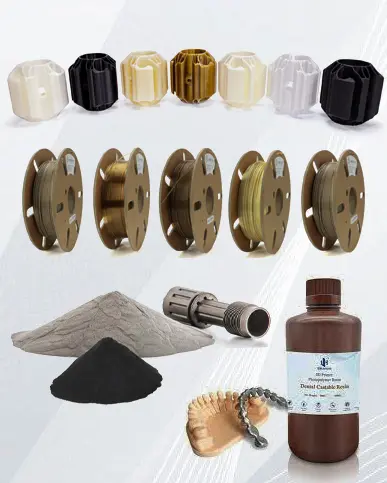
On the polymer side, PA12 nylon is the workhorse powder for laser sintering, backed by PA11 for higher impact toughness and by glass-filled and aluminium-filled grades when stiffness matters more than elongation. TPU powders produce flexible, rubber-like parts for seals, grips and padding. Unused powder is recovered, sieved and blended back with virgin material, which keeps polymer PBF economical in small series production. Properties are broadly consistent in all directions, though a part is usually strongest in the plane of its layers.
Post-processing after the build
A PBF part is not finished when the machine stops. Post-processing decides whether it meets a drawing or fails inspection, and it drives a large share of the cost per part.
Depowdering and support removal
Metal parts come out buried in a cake of loose powder. Depowdering involves vacuum recovery, brushing and bead blasting to clear internal channels and fine features that powder likes to pack into. Supports are then cut away with hand tools, machining or wire EDM, and the witness marks they leave are ground back. Polymer parts need less work: a bead blast and a brush usually finish the job.
Heat treatment
Laser metal builds carry residual stress from rapid heating and cooling, so stress relief heat treatment is standard before supports are removed for crack-sensitive alloys. Safety-critical parts often go further, with hot isostatic pressing to close internal porosity and, for some alloys, solution treatment and ageing to reach the specified strength. EBM titanium parts frequently skip stress relief because the hot bed already did part of that work.
Surface finish
As-built surfaces are rough, and EBM parts are rougher than laser parts. Machining brings critical interfaces, bores and sealing faces to tolerance. Shot peening and vibratory finishing improve fatigue life and appearance, while electro-polishing smooths medical implants and interiors that no tool can reach. Internal channels can only be finished by flow-based methods, which is worth remembering when you place them in a design.
Where powder bed fusion is used in production
Aerospace and aviation
Aerospace adopted metal PBF early, driven by the need to cut component weight without giving up structural integrity. Brackets, housings and ducting now leave the powder bed as a matter of routine, on commercial aircraft and military platforms alike, and engine manufacturers have qualified laser PBF parts for use inside modern turbofan engines. Satellites and rocket engines gain from lightweight geometries that cut launch mass, and the vacuum inside an EBM machine suits titanium aerospace parts especially well.
Automotive manufacturing
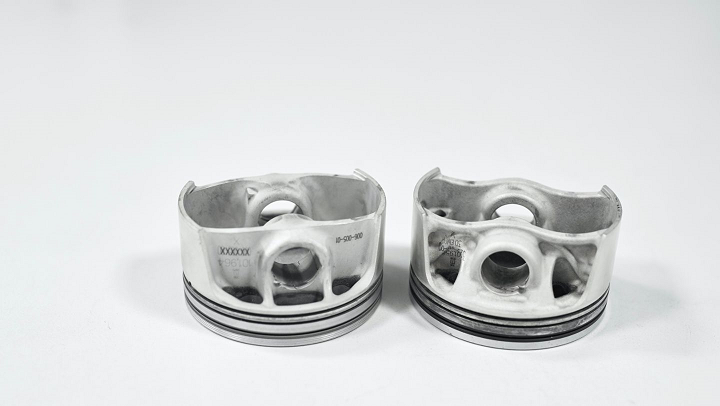
High-performance vehicles were the entry point. Additively manufactured pistons for a high-performance sports car engine proved that a printed engine component can outperform the conventionally manufactured part it replaces. Topology optimisation and bionic structures let engineers strip mass from stressed areas while matching or beating the strength of the original design. As build rates rise, adoption keeps moving from motorsport and luxury vehicles towards mainstream production parts.
Medical implants and dental work
Orthopaedics is one of the highest-volume PBF applications in the world, where hip stems, knee implants and spinal devices are turned out in their millions each year on laser and electron beam machines. Patient-specific implants designed from CT or MRI scans give surgeons a fit that a catalogue part cannot match. Hospital point-of-care printing centres now produce surgical guides and anatomical models for pre-surgical planning as well as custom implants. Porous structures that encourage bone ingrowth are easy to build and highly valuable for long-term implant success.
Dentistry came first and remains one of the most mature uses of the technology. Crowns, bridges and dental frameworks are produced in very large numbers, with fine resolution and smooth surfaces that meet the demands of restorations. Digital workflows now link the intraoral scan, the CAD design and the printer, which shortens lead times and gives more consistent results than traditional casting.
Industrial tooling and fixtures
Tooling is where PBF pays back fastest for many workshops. Conformal cooling inserts in tool steel cut moulding cycle time, reduce warpage and reach hot spots that straight drilled channels cannot. The same capability covers jigs, fixtures, grippers and end-of-arm tooling, where a part can be redesigned for function instead of for machinability.
How PBF compares with other metal additive processes
Directed energy deposition (DED) feeds powder into a focused beam. It suits large parts and material efficiency, and it can add metal to an existing component, but surface finish and detail resolution sit well below PBF and more machining follows.
Binder jetting builds faster and costs less on equipment, yet the green part must be sintered or infiltrated to reach full density. PBF delivers a dense part straight off the machine, which matters when properties have to meet a specification without extra steps.
Sheet lamination and other metal AM methods remain niche beside a production-proven PBF base with broad material selection, established qualification routes and multiple machine builders.
Choosing a PBF system in Malaysia
PBF machine classes have separated into clear bands. Entry-level benchtop metal systems with a single laser now bring laser PBF within reach of workshops, dental labs and job shops. Mid-range industrial machines add larger build volumes and stronger process monitoring. Multi-laser production systems and EBM platforms sit at the top, aimed at aerospace and implant manufacturers running qualified processes.
Compare systems on the things that decide your operating cost: build volume against your part envelope, laser count and power, the documented material qualification data for the alloys you intend to sell, powder recovery and sieving, gas consumption, and how much of the workflow the software automates. Support generation, nesting and build simulation save more time in daily use than a small gain in maximum build height. Local service matters too, because a metal PBF machine that sits waiting for a spare part is an expensive piece of furniture.
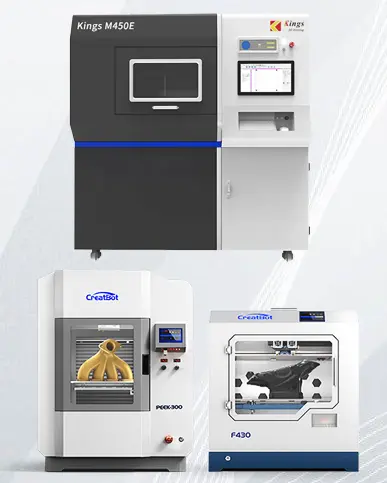
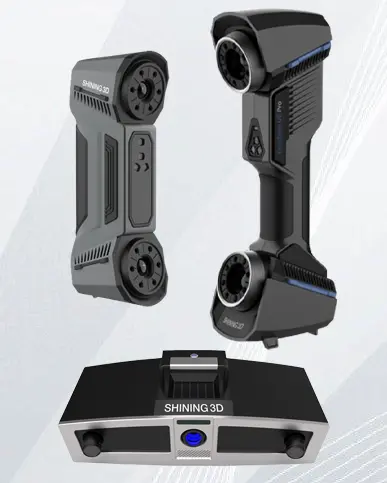
Trinventor Solution supplies metal and polymer additive systems, including FastForm benchtop laser PBF machines and EPlus3D platforms, alongside the industrial 3D printers and scanners and reverse engineering tools that feed them. If you already have a printed part and need to know whether it matches the drawing, 3D inspection and metrology closes that loop.
Frequently asked questions
What is the difference between SLS and SLM?
SLS originally described sintering, where powder particles bond without fully melting, and it is now used mostly for polymer machines that print nylon. SLM and DMLS describe laser systems that melt metal powder completely. Both are powder bed fusion processes, and modern metal machines reach near-full density, so the distinction matters less than the material and the machine specification.
Do powder bed fusion parts need support structures?
Polymer laser sintering does not need them, because the surrounding powder holds overhangs in place. Metal PBF does, both to anchor overhanging regions to the plate and to conduct heat out of the melt pool. Those supports are generated automatically in the build preparation software and removed during post-processing.
Is a PBF part as strong as a machined part?
For a qualified alloy and process, powder bed parts reach mechanical properties comparable to wrought or cast material of the same grade, and titanium printed by laser PBF typically meets or exceeds the relevant ASTM and AMS specifications. Final properties depend on build orientation, heat treatment and any hot isostatic pressing, so the print direction is a design decision, not an afterthought.
How thick is a typical layer?
Laser metal builds usually run between 20 and 50 microns per layer. Finer layers give better surface finish and detail at the cost of build time. Polymer sintering commonly runs at a coarser layer, closer to a tenth of a millimetre, and electron beam machines sit at the heavier end of the range.
Can leftover powder be reused?
Yes, and it is central to the economics of the process. Unused powder is recovered from the build chamber, sieved and blended with virgin powder at a defined refresh ratio set for that alloy. Metal powders need controlled handling because reactive alloys such as titanium can ignite when airborne, which is why powder management and inert handling form part of any sensible machine specification.