FastForm Metal 3D Printers: 1,000 LPBF Units Shipped In H1 2025
FastForm Metal 3D Printers: 1,000 LPBF Units Shipped In H1 2025
Quick verdict: FastForm moved close to 1,000 laser powder bed fusion machines in a single half-year, which tells you affordable metal printing has stopped being a demonstration and started being a purchase order. If you machine small, complex metal parts in modest batches, a benchtop LPBF machine now belongs on your evaluation list.
Over the first six months of 2025, FastForm delivered close to 1,000 laser powder bed fusion (LPBF) metal 3D printers. Set that against the roughly 500 machines the company had shipped in all the years from 2016 to 2024, and the direction of travel is hard to argue with.
This article explains what the milestone actually tells a buyer, what sits inside a FastForm machine, and how a Malaysian manufacturer should weigh up bringing metal printing in house.
What the 1,000 unit milestone actually tells you
FastForm trades as Meiguang (Jiangsu) 3D Technology Co., Ltd. It was founded in 2016 by researchers with PhD backgrounds from Huazhong University of Science and Technology, several of whom had worked at a supplier of laser cutting and marking systems. That background shows in the hardware. The early products were mid-market industrial platforms. Later the company turned towards compact benchtop LPBF machines, designed around simple operation and a low total cost of ownership.
The two delivery figures are what make the announcement worth reading. Around 500 machines sold over nine years. Nearly 1,000 in six months. The company has stated an ambition of passing 10,000 units within three years, which would place it among the highest-volume LPBF suppliers anywhere.
Scale of operation matters too. Buyers in more than 50 countries run FastForm equipment, and the installed client list sits above 300 businesses. The investor register includes Suzhou Yongxin Fangzhou, Walden International and Shanghai Jinpu Kunwen Investment Management. Reach that 10,000 unit target and FastForm sits in the same volume bracket as the established European and American industrial builders that shaped this category from the start.
Push button metal: why compact machines change the sums
FastForm’s growth rests on an argument the industry calls push button metal. The claim is that metal additive manufacturing develops in two directions at once: large industrial systems for certified volume production, and compact machines that any competent machine shop can install, learn and run without a dedicated additive department.
Under the older model, a metal LPBF installation meant an outlay only well-funded operations could carry, plus the facility work that follows it. A dedicated cell. Reinforced flooring. An inert gas set-up sized to the machine. That combination kept the buyer list short. Lower the cost band and shrink the footprint, and the same technology becomes relevant to dental labs, job shops, tool rooms, product developers and small aerospace subcontractors. The 1,000 unit figure measures that wider buyer list rather than any single specification.
Value-engineered metal systems had already shown that demand existed below the traditional entry threshold. FastForm appears to have pushed the entry point lower again, with the DeskFab X1 at the bottom of the ladder and the rest of the range stepping up from there. The shape of the offer is deliberate: start small, then scale as your metal order book grows.
What changes when metal printing moves to the bench
Consideration
Industrial metal LPBF cell
Benchtop LPBF machine
Capital outlay
Large enough to need board approval and formal capital planning
Small enough to assess like other workshop equipment, with leasing or vendor finance in reach
Floor space
Dedicated cell, often with reinforced flooring
Bench or pallet footprint, some models sized to pass through a standard doorway
Installation
Explosion-proof ventilation and extensive inert gas infrastructure
Simpler installation and gas handling
Operators
Trained additive technicians
Simplified software workflows and integrated powder management reduce the specialist requirement
Materials
Alloy library aimed at certified industrial production
Published specs list CoCr, titanium, stainless steel, copper and aluminium
Throughput
Built for volume output
Suited to small batches and high-mix work
Typical user
Large tool rooms and aerospace prime contractors
Dental labs, job shops, product developers, small subcontractors
Inside the FastForm range
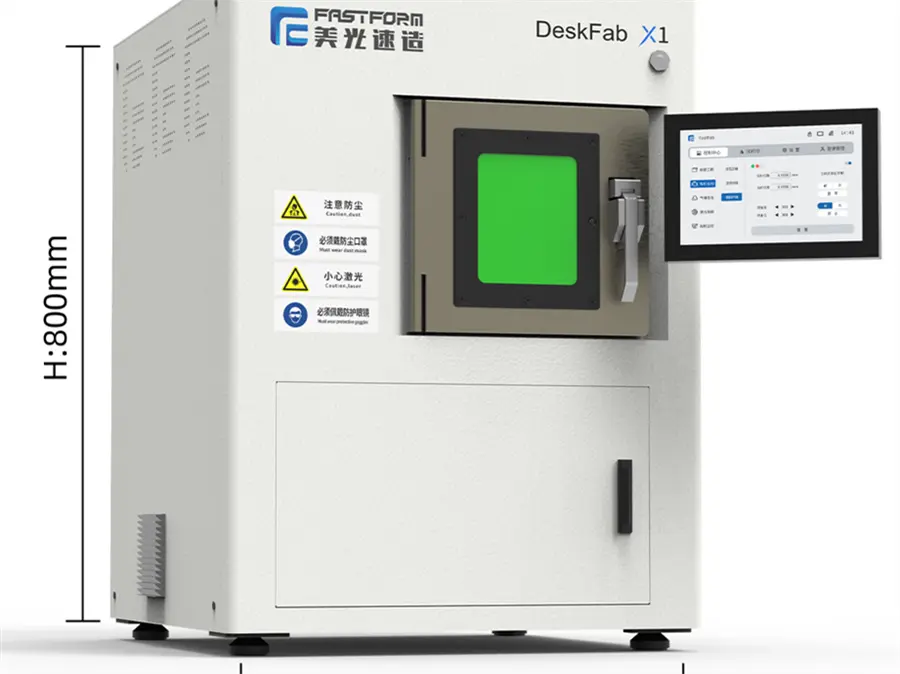
The DeskFab X1 is the entry machine. It measures approximately 80 by 65 centimetres and runs a 300W laser. Nothing about those dimensions suggests an industrial hall, and that is the point.
What the DeskFab X1 prints
According to published specifications, the machine processes cobalt-chrome (CoCr), titanium, stainless steel, copper and aluminium. Read that list against the rest of the entry-level market and the difference stands out. Most compact metal systems handle a narrow alloy set, usually dental CoCr or titanium. Adding aluminium and copper widens the range of parts worth considering to aerospace brackets, automotive components and electronics hardware, which is where a good deal of Malaysian subcontracting work sits.
FastForm has positioned the range for dental work, consumer electronics manufacturing and shoe mould production. Those sectors share a profile: modest batch sizes, parts with awkward geometry, and a need for durable metal components that conventional machining finds expensive to produce.
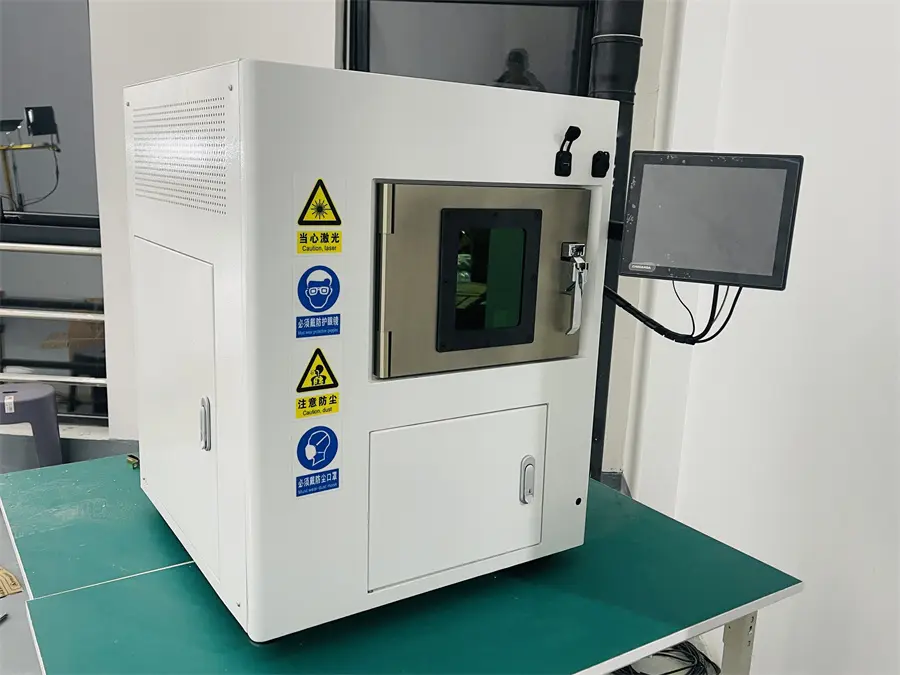
Installation is the part buyers underestimate. A benchtop LPBF machine still needs a level surface, a power supply, gas and disciplined powder handling, but it does not need the production room an industrial system demands. On a shop floor like this one the printer sits beside the existing bench, and the operators are the people already running the milling machines.
The equipment around the printer
A metal printer on its own does not finish a part. FastForm also supplies the supporting kit a metal shop needs: powder drying ovens, heat treatment furnaces, saws for cutting builds off the plate, and sandblasting cabinets. Sourcing those through one supplier shortens the list of unknowns for a first-time metal buyer, who would otherwise have to work out the whole downstream chain alone.
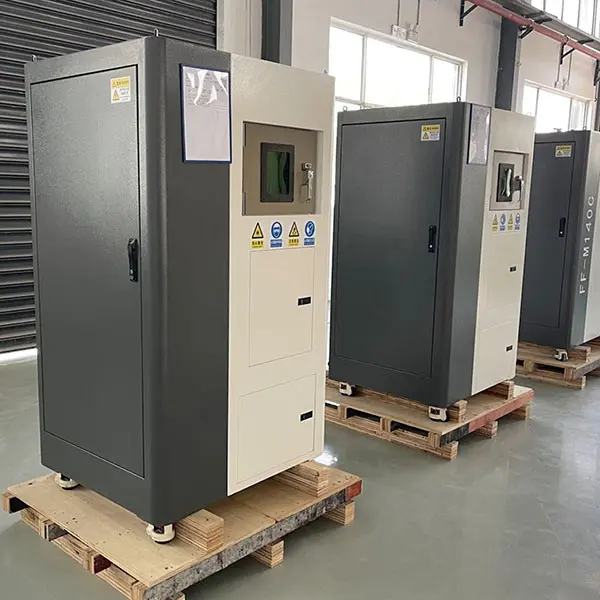
Physical logistics have had attention as well. Some models are engineered to sit on a standard pallet and pass through a standard doorway, which solves a practical problem that has quietly kept metal equipment out of older factory units.
What in-house metal LPBF changes for a Malaysian manufacturer
Three things shift once the machine becomes small and accessible.
Capital access. A metal system that costs as much as a building extension needs board approval and a business case built over years. At workshop scale the purchase can be judged against a specific job, funded through equipment leasing or vendor finance, and justified on a much shorter horizon.
Facility load. Compact units do not call for a dedicated additive production room, explosion-proof ventilation or heavy floor reinforcement. Capacity can be added in steps instead of in one large commitment, which suits a business testing a new service line.
Workforce. Simplified software workflows and integrated powder management cut the depth of specialist knowledge needed to keep the machine productive. The people already running your CNC machines are the people who can run a benchtop metal printer.
How to evaluate benchtop metal LPBF before you commit
Volume deployment in other markets does not automatically make the technology right for your factory. The criteria that decide success have not changed, and they are worth running through before any demonstration.
Geometry and orientation. Some features suit layer-by-layer building and some do not. Orientation choices drive both quality and cost per part.
Surface finish and post-processing. Know what finish comes off the plate and what your finishing route looks like before the machine arrives, not after.
Material certification. If your customer demands certified material and process records, ask early how the machine and the powder supply support that paperwork. Our 3D inspection solutions cover the verification side of this.
Throughput against conventional methods. Match build rate to your order book rather than to a specification sheet.
Total cost of ownership. Powder consumption, inert gas, build cycle times and post-processing labour all sit on top of the machine, and they decide the real cost per part.
What has changed is the entry point. A small Malaysian aerospace subcontractor can now run qualification trials on a titanium part and test it against aerospace quality expectations such as AS9100 or NADCAP without the capital commitment an industrial system would demand. That is a very different conversation from the one buyers were having five years ago.
Machines leaving the plant in batches like these are the other half of the story. Delivery at this volume supports a powder and spares supply chain that simply did not exist when compact metal printing was a novelty, and a supply chain is what keeps a machine earning after the first year.
Competitive dynamics in the metal LPBF market
FastForm’s volume growth has arrived at a moment of pressure in metal LPBF. The strategy behind it is not only about machine sales. Competitive pricing builds an installed base, and an installed base generates the consumables and service revenue that funds the next round of price competitiveness, technical support and development. European and American builders, whose cost structures grew around lower volumes and higher margins, feel that pressure directly.
If the 10,000 unit target is met, FastForm would hold a service and consumables base large enough to keep funding all three. The likely response from established makers is tighter focus on high-throughput, large-format systems for aerospace and defence work, where process proof and certification carry more weight than the cost of entry. You can see our own metal SLM printers for how that industrial end of the market is served.
FastForm LPBF metal 3D printing: key facts
Fact
Detail
Company
FastForm, trading as Meiguang (Jiangsu) 3D Technology Co., Ltd.
Founded
2016, by PhD researchers from Huazhong University of Science and Technology
Units shipped, 2016 to 2024
Approximately 500
Units shipped, H1 2025
Nearly 1,000 LPBF machines
Stated target
A stated goal of 10,000-plus units within three years
Reach
Equipment in service in more than 50 countries; over 300 clients
Entry model
DeskFab X1, approximately 80 by 65 centimetres, 300W laser
Did FastForm really ship 1,000 metal printers in six months?
Close to it. The company reported nearly 1,000 LPBF units delivered in the first half of 2025, against roughly 500 units in total from 2016 through 2024.
What is laser powder bed fusion?
LPBF is a metal additive process. A laser traces the shape of each layer across a bed of fine metal powder and fuses it, a fresh layer of powder is spread on top, and the next layer is fused onto the one below. The result is a dense metal part built from your CAD data, with support structures removed afterwards.
Which materials can a benchtop metal printer handle?
It depends on the machine. FastForm’s published specifications for the DeskFab X1 list cobalt-chrome, titanium, stainless steel, copper and aluminium. That is a wider set than most entry-level systems, many of which are limited to dental CoCr or titanium.
Do compact metal printers need special facilities?
They need less than a full industrial cell. Explosion-proof ventilation, reinforced flooring and extensive inert gas infrastructure are not part of the picture. Powder handling, protective equipment, extraction and local safety requirements still apply, and the machine maker’s guidance should be followed.
Is benchtop metal LPBF worth it for a small Malaysian factory?
That depends on your parts. Complex geometry in modest batches, hard-to-machine alloys and a need to move quickly on design changes all point towards additive. Simple, high-volume metal parts usually stay cheaper to mill or cast. Ask for a realistic cost-per-part estimate across several jobs before you decide.
Looking for the right solution for your application? Our team is here to help. Talk to our 3D solution specialist today.