Glass and Crystal Laser Engraving in Malaysia: From Frosting to 3D
Glass and Crystal Laser Engraving in Malaysia: From Frosting to 3D
Quick verdict: Glass needs a UV laser. A CO2 or fiber laser heats the glass and cracks it; a UV laser marks cold, so you get clean surface marks and can even engrave 3D images inside solid crystal. The machine for both jobs is the xTool F2 Ultra UV.
Glass is the material everyone wants personalised and the material most machines ruin. A conventional laser pushes heat into the surface, and glass — hard, brittle and often thin-walled — answers with a crack. Handled with the right process, the same piece takes a crisp frosted mark, or an image suspended inside solid crystal.
Both are glass work, but they use different physics and they fail for different reasons.
Why glass and crystal are the hardest common material
Wood absorbs laser energy; metal conducts it away. Glass does neither well — it is transparent to some wavelengths, brittle to all of them, and it carries internal stress from the day it was formed.
That produces three distinct failure modes.
Heat cracking. A beam that heats the surface faster than the glass can spread that heat creates a sharp temperature gradient. The surface expands, the material beneath it does not, and the piece cracks along the mark — sometimes at once, sometimes days later.
No mark at all. Wavelengths that pass through clear glass never couple with it, so the beam travels straight through and leaves nothing behind.
Damage you only see later. A stressed piece can look perfect under the machine and fail when it is washed, chilled or dropped. Rim edges fail first.
Why UV, not CO2, for glass
Technology
Effect on glass
Risk
CO2 (10,600 nm)
Surface frosting only
High — heat cracks and chips glass
Fiber
Barely marks clear glass
Wavelength passes through
UV (355 nm)
Clean surface + internal marking
Low — cold processing
A UV laser marks glass “cold” — it doesn’t build up heat, so it won’t crack the piece. It also focuses inside the material, which is what makes 3D crystal engraving possible.
Cold marking breaks bonds at the surface rather than melting it: no molten edge, no scorching, no yellowing. Because 355 nm is absorbed at the surface instead of passing through, it marks clear glass and crystal that a fiber laser would ignore. For a wider comparison, see CO2 vs fiber vs UV lasers.
Two kinds of glass engraving: surface marks and inner 3D
Surface engraving marks the outside of the piece. The laser roughens a microscopic layer, leaving a frosted white mark that reads like etched glass. It does not fade in a dishwasher, and it is the right answer for logos, monograms, names and dates.
Inner 3D engraving — sub-surface engraving — leaves no mark on the outside at all. The beam is focused through the polished surface and creates thousands of tiny fracture points inside the material, forming an image that resolves when you look into the block.
Many premium jobs use both: a frosted company name on the outside of a crystal award, with the recipient’s subject engraved in three dimensions inside it.
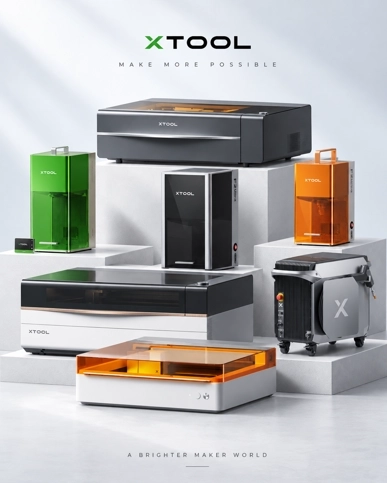
The machine: xTool F2 Ultra UV
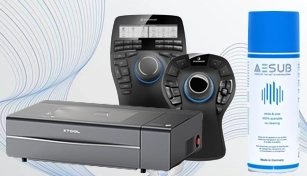
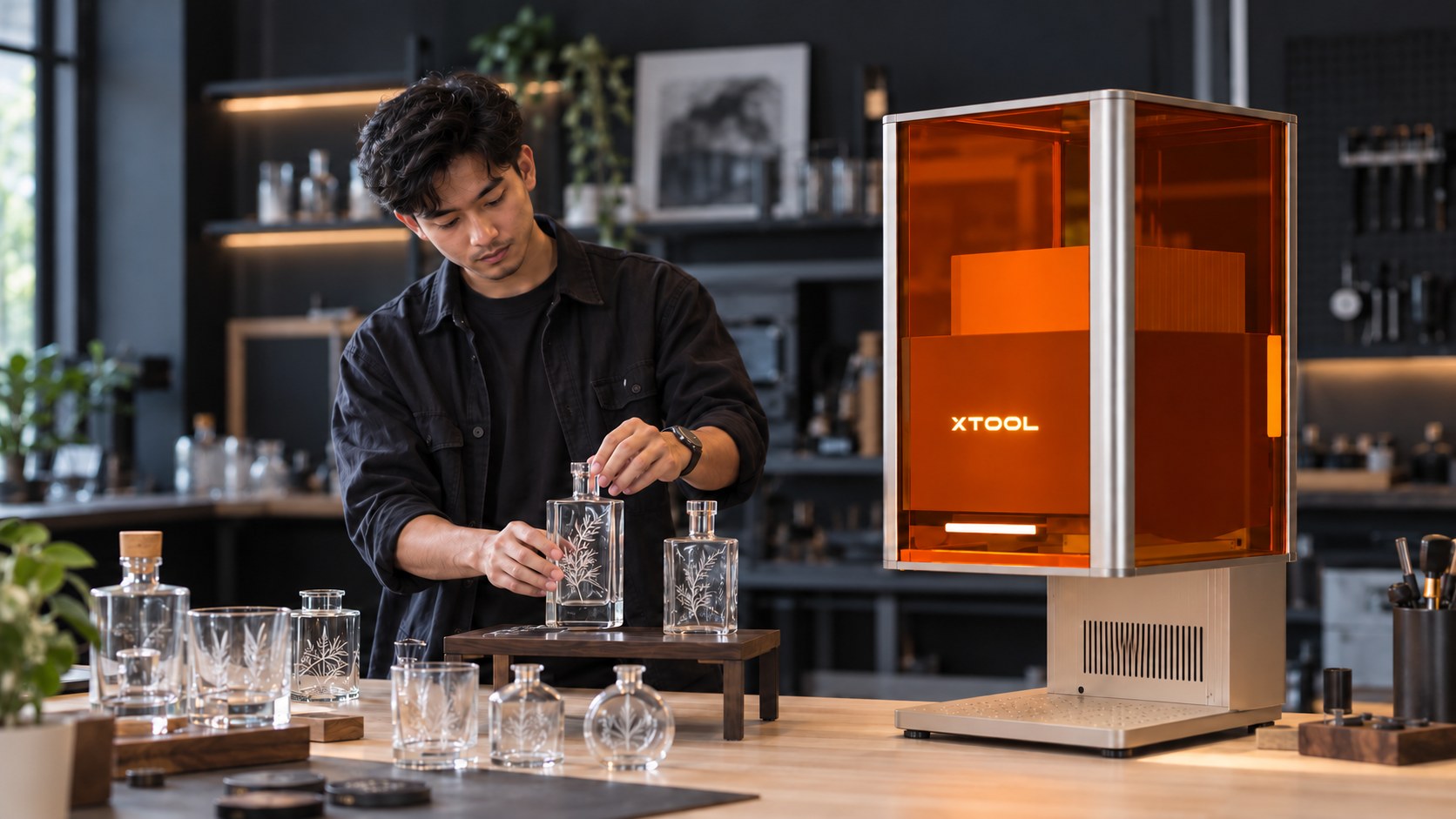
The UV process needs a source that produces ultraviolet light — that is what the xTool F2 Ultra UV is built for.
One UV source covers both jobs: frosting the surface, and building an image inside the glass.
The F2 Ultra UV is built for exactly this work:
5W UV laser (355 nm) — spot size under 10 microns for fine detail.
Cold marking — a surface reaction rather than a burn, so no cracking, charring or discolouration.
Internal engraving — the same source focuses inside crystal to build 3D point-cloud images.
Surface engraving — frosted logos and wording on glassware, bottles and flat panels.
Heat-sensitive materials — equally suited to fine plastics, coatings and printed surfaces.
For cylindrical work such as tumblers and bottles, a rotary attachment is available as an optional accessory, sold separately, so the full circumference can be marked.
Designing a file for inner engraving
Surface engraving is a two-dimensional problem. Inner engraving is a three-dimensional one, and most of the design work happens before the machine is switched on. The viewer sees through the block, so the front face acts as a window and the picture behind it reads as a depth volume.
Decide which face the customer looks through. Text and figures are oriented for that face; from the opposite side, the same engraving reads reversed.
Keep the subject clear of the edges. Points placed too close to a face or a corner read as scratches rather than as part of the image.
Depth is part of the design. Near the front face the subject is crisp; placed deeper, it floats with more separation inside the block, which looks more impressive but demands a cleaner source file.
A single, well-lit subject reads better than a crowded scene, because the image is built from contrasts in the source. Busy backgrounds turn into visual noise — for portraits, a clean cut-out is the difference between a face and a grey haze.
No two glass blanks behave identically, and this is where most of the practical difficulty sits. Composition, lead content, wall thickness, curvature and surface coating all change how the material reacts to the beam.
Crystal is not a single material — a block with a high lead content marks differently from a lead-free one. Sprayed and lacquered bottles carry a coating that has to be penetrated or avoided, and a mark that looks right on the sample can look different on the production batch. Recycled glass is the most variable of all.
Curved surfaces add a second variable: focus drifts as the surface falls away from the centre of a bottle, so a mark can lose definition towards the edges.
Test the actual production blank, not a similar one — a sample from a different supplier tells you little. Once a blank is proven, keep a marked sample on the shelf so new deliveries can be checked against it.
Photographing glass and crystal
Photographing this work is genuinely difficult. The mark is white or grey against a transparent body, so there is almost no contrast for a camera to lock onto, and auto-exposure flattens the engraving into nothing.
Reflections are the second problem: a polished bottle acts as a mirror, recording the lights and stands on the product.
Three habits fix most of it. Use a dark, plain background so the mark has something to read against. Light from the side or slightly behind, so the frosted texture shows as a visible line rather than a washed-out patch. And shoot the mark rather than the object — a photograph of a whole bottle says almost nothing about the quality of the work.
Inner engravings follow the same logic: a dark backdrop with directional light makes the point cloud glow inside the block, so it is worth building one repeatable setup.
Frequently asked questions
Will a laser crack my glass? Not with a UV laser, which marks cold and does not build up heat in the material. Heat-based processes are the ones that crack glass, particularly on thin walls and rim edges.
Can you engrave inside a crystal block without opening or cutting it? Yes. The beam is focused through the polished surface and the image forms inside the material, so the outside stays smooth and untouched.
Which machine do I need for glass and crystal? A UV laser — the xTool F2 Ultra UV handles both frosted surface marks and internal 3D engraving. A CO2 or fiber machine is the wrong tool for this material.
How is pricing for a glass engraving setup determined? Cost depends entirely on configuration — the machine, the accessories and the products you intend to run. We do not publish figures; request a quotation and we will put a configuration together around your work.
Is the mark permanent? Yes — it is part of the glass rather than a coating on it, so it will not peel, fade or wash off.
Glass varies — thickness, lead content and coating all affect the result, and the only way to know is to test. Send us a bottle or a glass and we’ll engrave a sample so you can check the finish yourself.
Bring a crystal award blank and we will mark a frosted logo on one face and an inner 3D image in the same piece, so you can judge both processes on your own material.
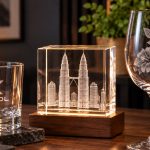
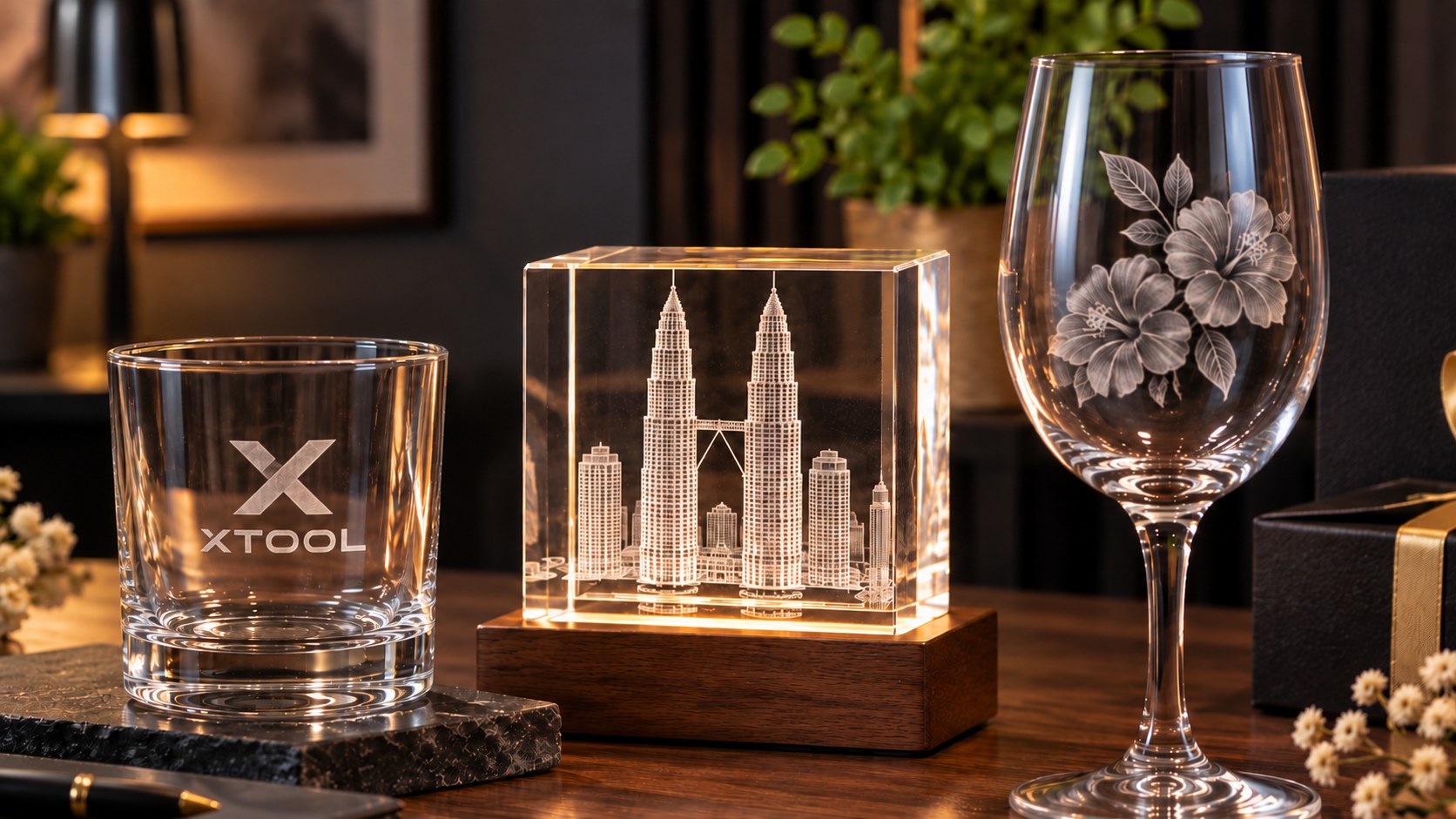
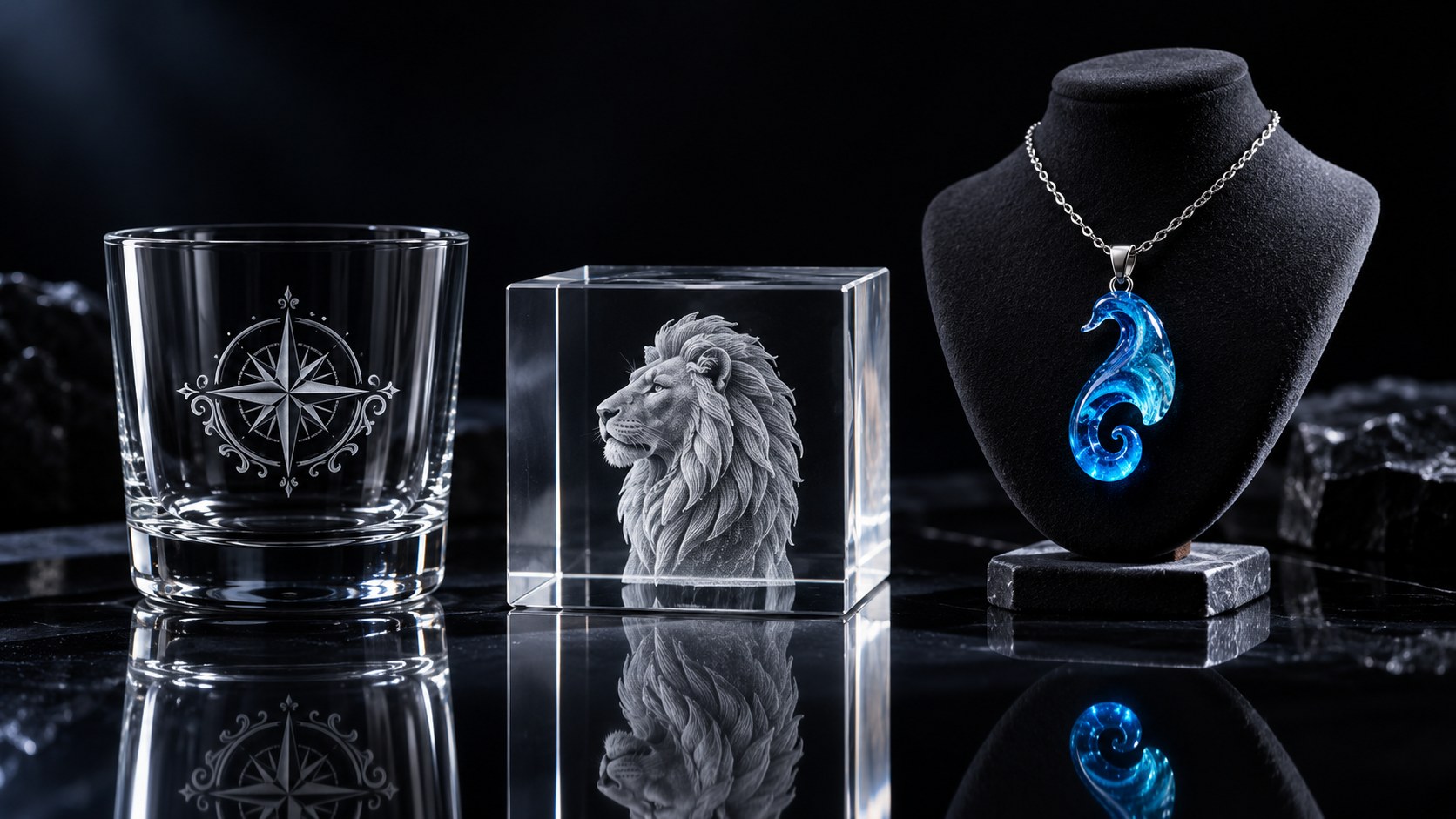
Frosted on the left, 3D inside the block in the centre, edge-lit on the right — three finishes you can compare side by side.
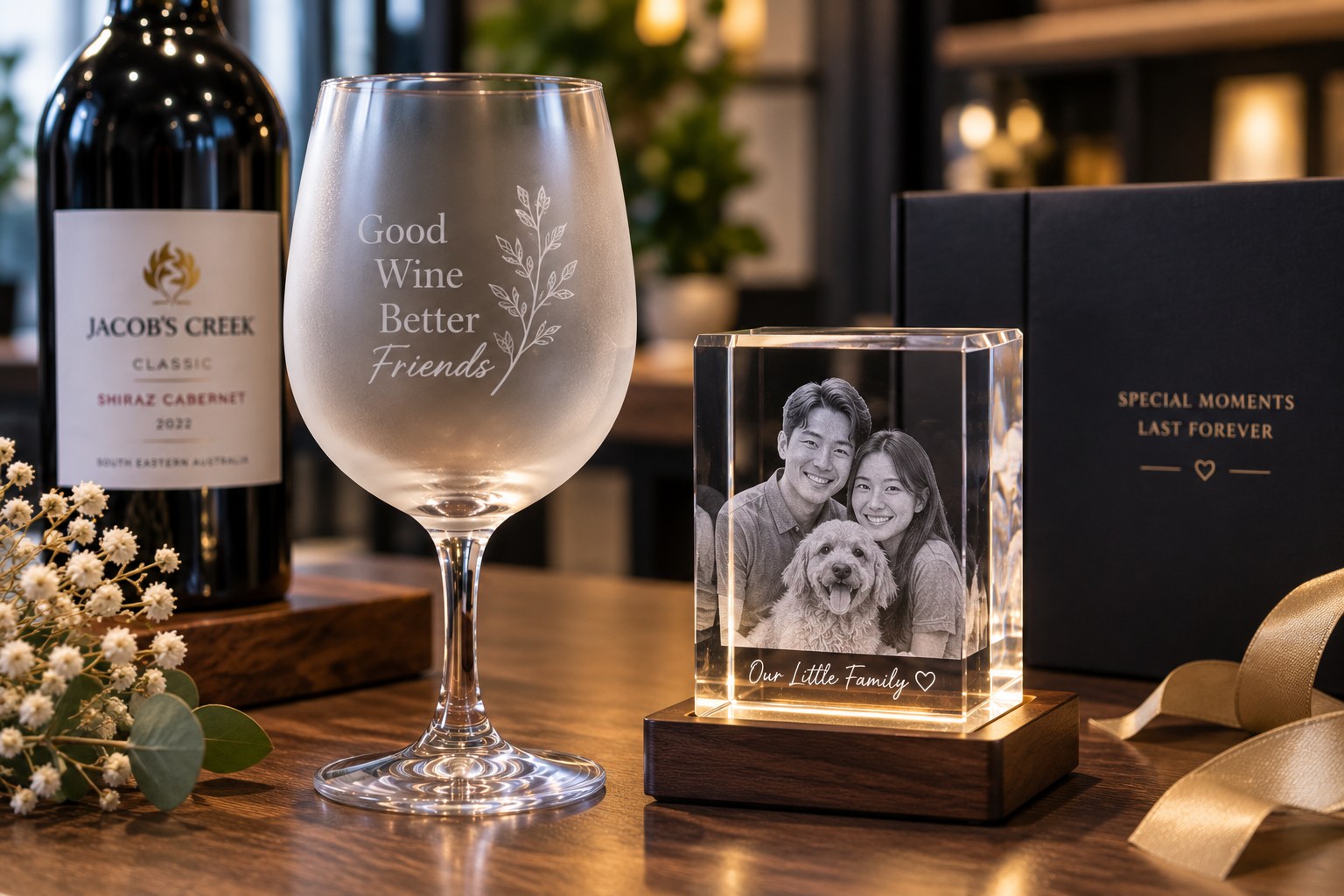
Both finishes on one table: a frosted surface mark on the glass, and a portrait engraved inside the block.
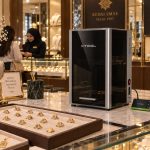
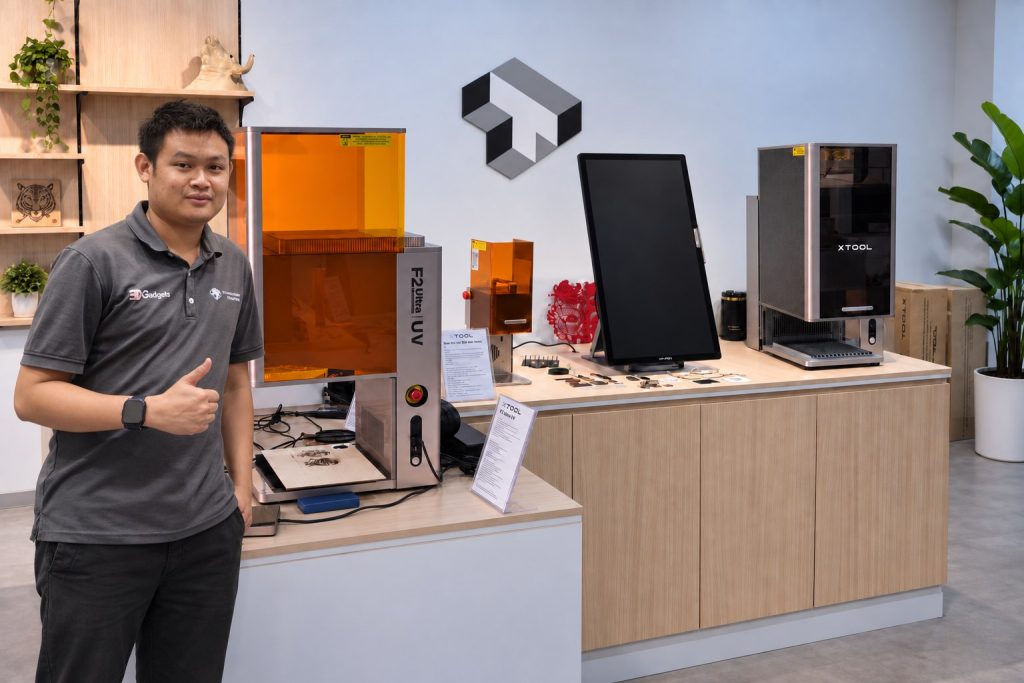
Our Kuala Lumpur showroom. Bring your product and we will engrave it in front of you, so you see the real result before you buy.
Laser engraving is easiest to judge in person. Tell us what you want to mark and bring a sample to the showroom, or send us a photo and we will tell you which machine and power fits the job.