
Handheld 3D scanner with robotic arm for automated data capture
3D Scanning Solutions by Industry in Malaysia
3D Scanning Solutions by Industry in Malaysia Quick verdict: Whatever your industry — automotive, mold...
3D scanning for education and research
3D Scanning for Education & Research in Malaysia
3D Scanning for Education & Research in Malaysia Quick verdict: For universities, polytechnics and...
3D scanning an infant's head for a cranial helmet
3D Scanning for Medical, Dental & Orthotics in Malaysia
3D Scanning for Medical, Dental & Orthotics in Malaysia Quick verdict: For orthotics, prosthetics...
3D scanning an energy pipeline for corrosion inspection
3D Scanning for Energy & Heavy Equipment Inspection in Malaysia
3D Scanning for Energy & Heavy Equipment Inspection in Malaysia Quick verdict: For energy operators...
No posts found
  • Article
  • >
  • 3D Scanning for Marine & Shipbuilding in Malaysia

3D Scanning for Marine & Shipbuilding in Malaysia

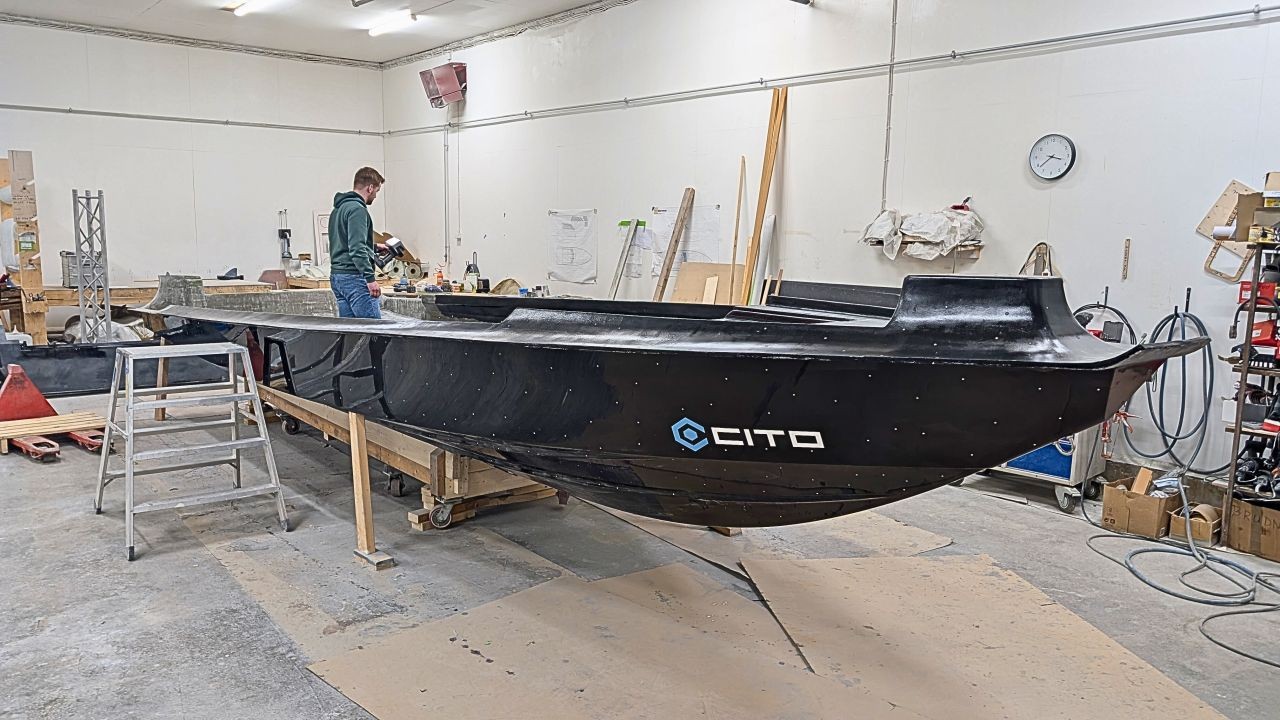
3D scanning an 8-metre rigid inflatable boat hull

Quick verdict: For boatbuilders, shipyards and marine service providers in Malaysia, 3D scanning turns a physical hull, propeller or worn component into an accurate digital model — for reverse engineering, inspection, FEA simulation and repair. Wireless and handheld scanners capture reflective and dark marine surfaces in minutes, replacing slow manual measurement.

Why marine engineering is going digital

Marine structures are large, curved and often built from dark or reflective materials — exactly the surfaces that defeat traditional measurement. Hulls have no flat reference planes; propellers have complex helical geometry; worn steering gears have no surviving drawings.

3D scanning captures all of it directly. A wireless or handheld scanner rebuilds the full surface as a dense mesh, which can be reverse-engineered into CAD, inspected against a reference, or fed into simulation software — without scaffolding, contact probes or hours of manual layout.

Digitizing an 8-metre hull

Traditional boatbuilding relies on generations of hands-on skill, but modern engineering demands a digital model. When a boatbuilder needed to digitize an 8-metre RIB (rigid inflatable boat) hull, a wireless standalone scanner was the answer.

The EinScan Libre captures the overall hull shape and fine structural details without a laptop — its built-in screen and onboard processor handle everything on the water. It handles the reflective and dark materials common in marine environments.

The resulting scan feeds directly into CAD for reverse engineering, FEA (finite element analysis) and hull performance simulation — accelerating design refinement and reducing manual rework.

Wireless 3D scanner capturing a boat hull

Propeller inspection without a pitchometer

3D scanning a ship propeller for inspection

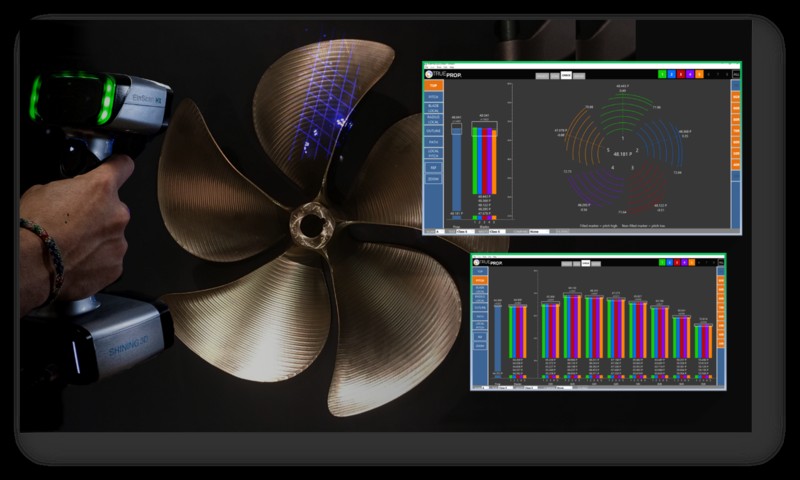
Ship propeller inspection has long relied on a pitchometer — a manual tool with significant limitations on complex helical blades. The EinScan HX, with hybrid laser and LED light sources, makes propeller inspection simple and efficient.

Combined with dedicated propeller inspection software, the scanner captures the full blade geometry and compares it against the design — turning a cumbersome manual process into a fast, repeatable digital one. The result is a cost-effective virtual inspection that catches pitch errors and wear before they cost performance.

Reverse engineering worn ship components

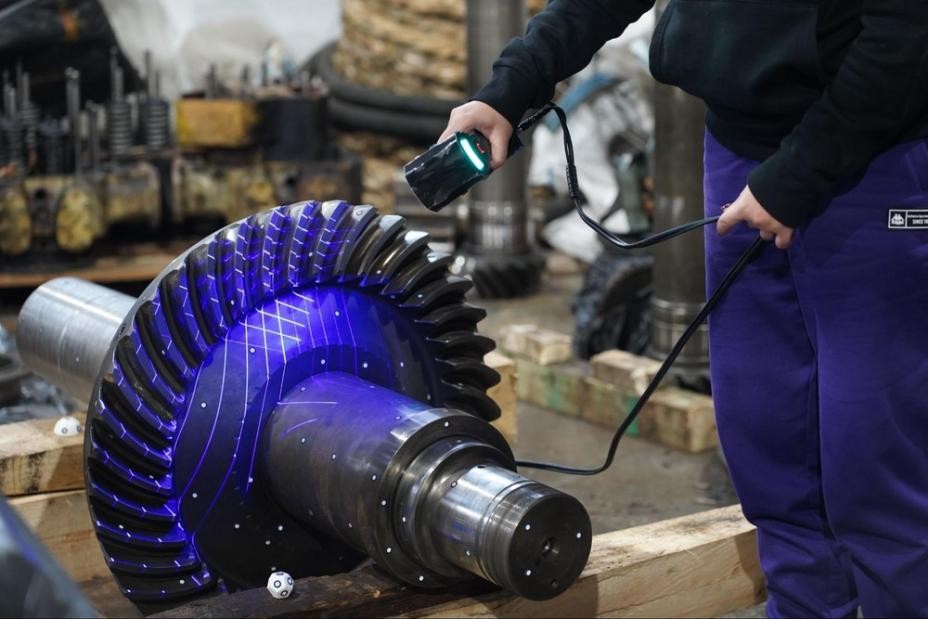
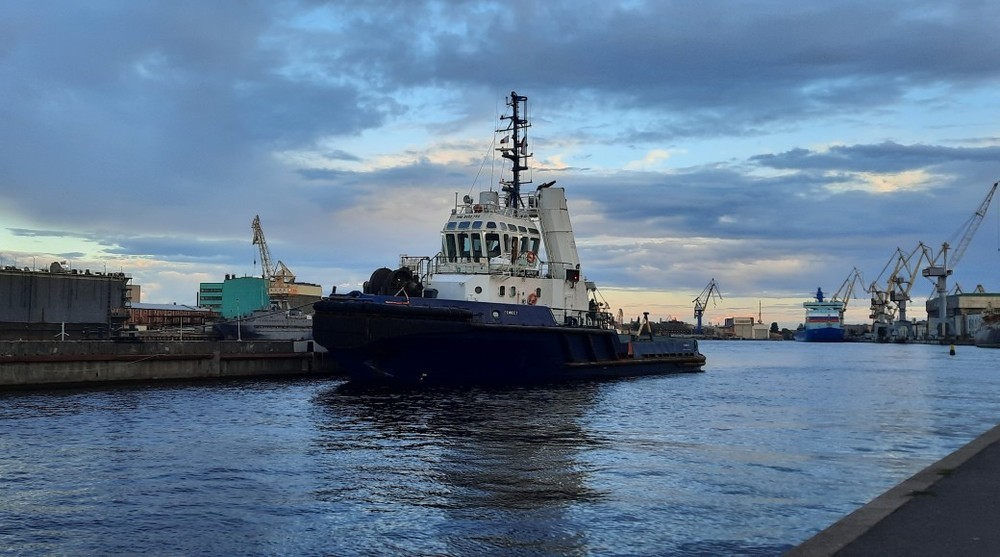
Ship maintenance means repairing large, heavy components that often have no surviving drawings. A tugboat operator needed to reverse-engineer the rotary gears on a steering column — a 360° rotating part that lets a tug maneuver in cramped harbours.

The FreeScan UE Pro2 handled it with 26+7+1 blue laser lines — cross lines for global scans and a single line for deep holes — at up to 0.02 mm accuracy. Built-in photogrammetry keeps large-volume scans accurate, producing a complete digital model for repair and fabrication.

3D scanning a ship component for reverse engineering

Reflective and dark surfaces, handled

Tugboat in a harbour

Marine materials — gelcoat, polished metal, dark composites — are notoriously hard to measure optically because they scatter or absorb light. The scanners recommended here are built for it: hybrid light sources, marker-free modes and laser lines tuned for reflective surfaces.

The payoff is a single workflow that covers the whole vessel lifecycle: new-build hull documentation, propeller and component inspection, and repair of legacy parts — all feeding scan-to-CAD reverse engineering.

3D scanning vs manual measurement in marine

Factor Manual / pitchometer Contact CMM 3D scanning
Hull & large structures Impractical Impractical Captures full hull
Propeller blades Slow, limited Point-by-point Full blade surface
Reflective / dark surfaces N/A N/A Handled (hybrid light)
Portability Portable Fixed Portable / wireless
Output Notes Points Mesh + CAD + simulation

Scanners we recommend for marine

  • EinScan Libre — wireless standalone scanner for hulls and large structures, marker-free with texture.
  • EinScan HX — hybrid laser + LED for propellers and versatile part sizes.
  • FreeScan UE Pro2 — metrology-grade handheld for reverse engineering worn components.
  • FreeScan Combo+ Wireless — wireless dual-light-source scanner for shop-floor and on-site inspection.

Malaysia-specific considerations

  • Shipbuilding & repair — Malaysia’s shipyards and marine-services sector (tugs, pilotage, offshore support) benefit from faster hull documentation and component reverse engineering.
  • On-site scanning — wireless scanners like the EinScan Libre work directly at the dock or slipway, with no laptop or cabling to manage in a wet environment.
  • Material challenges — gelcoat, polished metal and dark composites are common; choose hybrid-light scanners tuned for reflective surfaces.
  • Local support — calibration, training and on-site demos from a local vendor keep marine projects moving.

Our honest recommendation

For hull documentation and large structures, start with the wireless EinScan Libre. For propellers and mixed part sizes, the EinScan HX is the right tool. For reverse engineering worn components, use the FreeScan UE Pro2 with scan-to-CAD software.

FAQ

Can I scan a boat hull without a laptop?
Yes — the EinScan Libre is fully standalone, with a built-in screen and processor, so you scan directly at the hull.

Does 3D scanning work on reflective or dark marine surfaces?
Yes — hybrid laser/LED scanners are tuned for exactly these materials, often without spray.

Can I reverse-engineer a worn part for repair?
Yes — scan the part, build a digital model, and machine or fabricate a replacement from the CAD data.

Can scan data feed simulation?
Yes — reverse-engineered CAD models support FEA and hull performance simulation.

Need help choosing?

Tell us what you build, inspect or repair, and we will match the right scanner and software — with a live demo. Contact Trinventor Solution today.

Thank you for signing up. You will be the first to know the Industry news, upcoming products, latest technology and special promotion.

Stay Tuned.