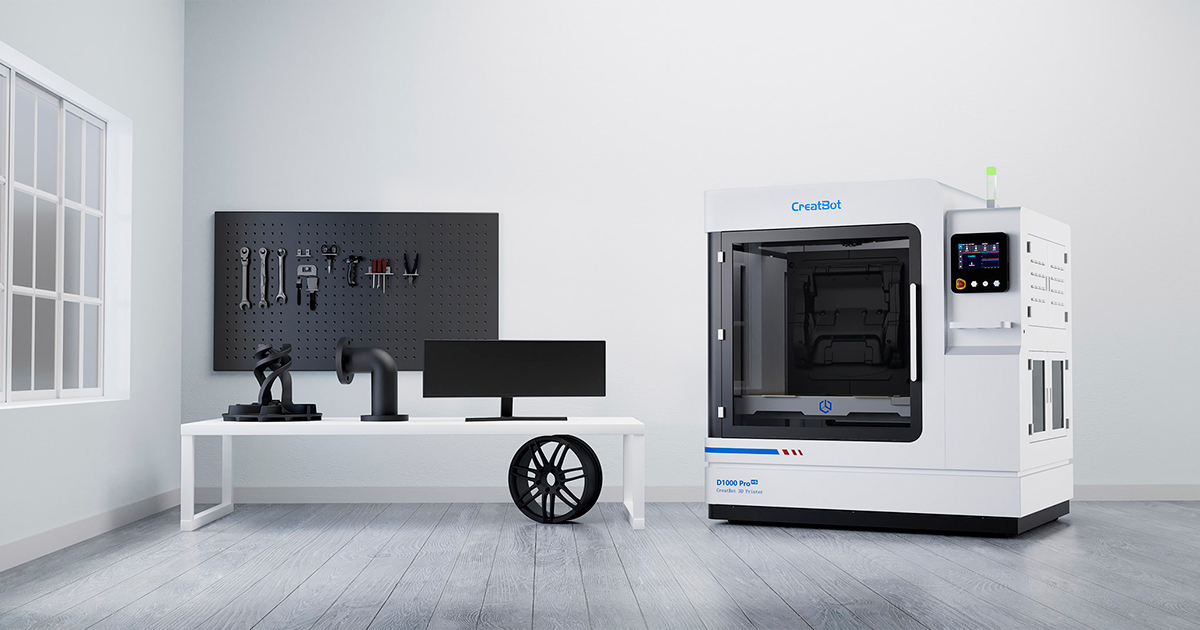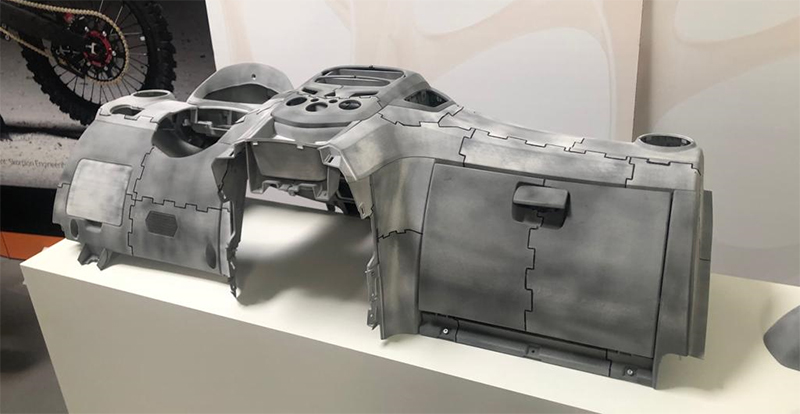
Large-format 3D printers have a build volume of roughly 400 mm to over 1 metre in at least one axis. That lets you print parts in a single piece instead of splitting them and gluing or welding — a huge advantage for strength and appearance.
Common applications include automotive panels and moulds, aerospace mock-ups, jigs and fixtures, architectural models, and large functional prototypes. Printing one solid part also removes weak glue joints that would otherwise fail under load.
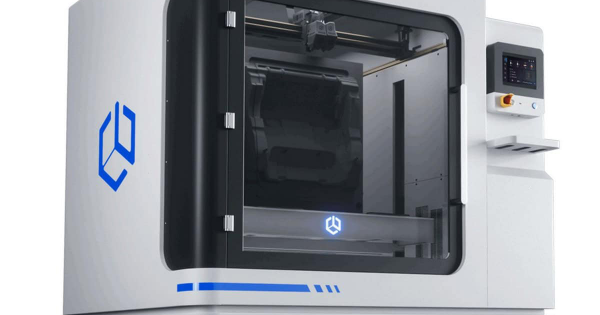
Machines we recommend: the CreatBot D1000 HS (up to 1 m) and the CreatBot D600 Pro2 HS for a high-speed industrial workhorse.


The biggest reason is structural integrity. A single printed part has no glue lines, so it handles load and stress far better than several pieces joined together.
It also saves assembly time — no fixturing, gluing or aligning multiple segments — and gives a cleaner finish, since there are no seams to hide or fill.
Finally, large-format machines often support engineering-grade filaments like ABS, nylon and carbon-fibre-filled materials, so the big parts are not just large but also strong and stable.
| Model | Build volume | Best for |
|---|---|---|
| CreatBot D400 HS | 400 × 400 × 600 mm | Entry large-format, medium parts |
| CreatBot D600 Pro2 HS | 600 × 600 × 600 mm | High-speed industrial production |
| CreatBot D1000 HS | 1000 × 1000 × 1000 mm | Full-metre parts in one piece |
| CreatBot D1000 Pro HS | 1000 × 1000 × 1000 mm | Metre-scale with advanced features |
| Tier | Price range (RM) | Build volume |
|---|---|---|
| Entry large-format | 20,000 – 40,000 | ~400 mm |
| Mid industrial | 60,000 – 100,000 | ~600 mm |
| Metre-class | 100,000 – 200,000+ | ~1,000 mm |
Large parts consume more material, so factor in filament cost and longer print times. See our 3D printer price guide for full brand and technology ranges.
If your parts genuinely exceed the desktop limit, a large-format machine pays for itself by printing them in one strong, clean piece. Most teams start with a 600 mm-class machine and move up to the metre-class D1000 HS when volume demands it.
If your parts are small, do not over-buy — a desktop or mid-size printer is faster and cheaper to run.
How big can a large-format 3D printer print?
Typically 400 mm up to 1,000 mm or more. The CreatBot D1000 HS builds a full 1,000 × 1,000 × 1,000 mm part.
Is it cheaper to print big parts in pieces and glue them?
Often cheaper in material, but you trade away strength and spend time on assembly and finishing. For structural parts, one piece is better.
Do large-format printers need a special room?
They need floor space, stable power and an enclosed, temperature-controlled environment for best results.
What materials can large-format printers use?
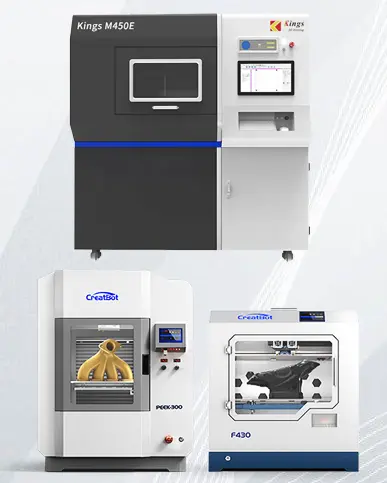
PLA, PETG, ABS, nylon and carbon-fibre-filled filaments, plus high-temperature materials like PEEK on suitable machines.
Send us your CAD or a sample part and we will recommend the right machine and material — with a live demo. Contact Trinventor Solution today.
Subscribe to our newsletter and stay updated.
Thank you for signing up. You will be the first to know the Industry news, upcoming products, latest technology and special promotion.
Stay Tuned.