Quick verdict: Perfume bottles are glass, and glass cracks under a hot laser. A UV laser marks cold — clean, permanent, and with no risk of cracking the bottle.
A personalised perfume bottle turns a product into a gift. A name, date or message on the glass makes it specific to one person — which is exactly why it sells at a premium for weddings, birthdays and retail.
The catch: perfume bottles are glass, and glass is the material most engraving methods ruin. Here’s how to do it without cracking a single bottle.
Why most lasers crack perfume bottles
A CO2 or fiber laser heats the glass as it marks. Heat builds up, and glass cracks. The method that works is a UV laser — it marks the glass cold, so there’s no thermal stress and no cracking.
Method
Effect on glass
CO2 laser
Heats → cracks / chips
Fiber laser
Barely marks clear glass
UV laser
Cold, clean mark — no cracking
How a UV laser marks glass without cracking it
UV light at 355 nm carries enough energy to break the bonds holding the glass surface together, so the laser lifts a thin layer of material away. This is cold ablation. Almost none of that energy becomes heat in the glass, so the bottle never expands and never cracks.
CO2 lasers at 10,600 nm and fiber lasers at 1,064 nm work the opposite way. They heat the glass until it changes, which is why they leave micro-cracks or shatter thick walls. Cold ablation sidesteps that entirely.
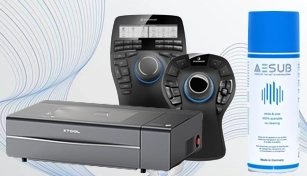
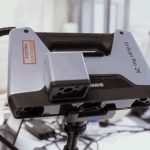
The machine: xTool F2 Ultra UV
The F2 Ultra UV is purpose-built for this:
5W UV laser (355 nm) — cold marking on glass, no thermal damage.
Fine spot size (under 10 µm) — crisp names and dates on small bottles.
Surface engraving — 200×200 mm, expandable for batch work.
Rotary capability (optional accessory, sold separately) — marks around the curve of a bottle.
Settings and technique
Lower power, multiple passes — mark gradually rather than one heavy pass.
Test on a spare bottle first — glass thickness and coatings vary.
Position carefully — the F2 Ultra UV’s cameras help you align text precisely on the curve.
Which bottle are you holding?
Perfume bottles are not one material. A thick decorative flacon behaves differently from thin-walled cosmetic glass, and a painted or metallised bottle is a different job again. Where the surface is coated, the laser may mark the coating rather than the glass beneath it, which changes the look.
Bottles with an internal lacquer or a coloured layer need the same caution. On clear glass the mark reads as a frosted, opaque white with fine detail. On anything else, assume nothing until you test it.
Artwork that suits glass
A frosted white mark has no tones: each point is either marked or it is not. A design built on colour fills and soft shading loses its shape on a bottle. Line work, monograms and outline lettering hold up better, and tone is best suggested with fine hatching rather than solid blocks.
Names set a few millimetres tall come out clean and readable, while a heavy filled logo that looks strong on wood can read as a white patch on glass.
What to offer
Names and dates — for weddings, anniversaries, birthdays.
Monograms and initials — for retail personalisation.
Brand logos — for boutique fragrance brands.
Batch event favours — personalised bottles for guests.
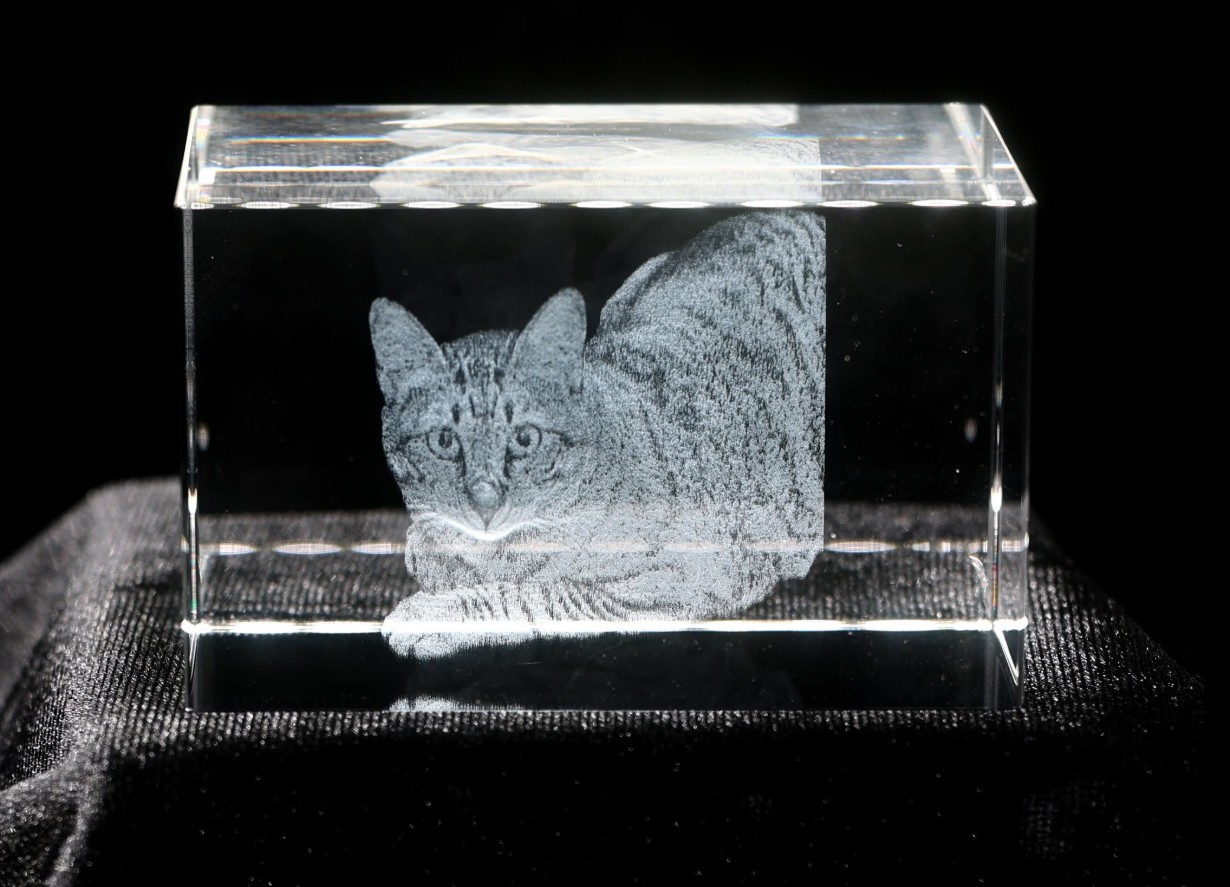
Engraving a 3D image inside crystal
UV is the only common laser type that can engrave a three-dimensional image inside a solid block of crystal. The beam passes through the polished surface and focuses at a point within the material, leaving a tiny fracture there. Thousands of those points together form an image suspended inside the block.
Nothing sits on the surface, so nothing can wear off. It suits crystal awards, anniversary and wedding pieces, and gift sets that pair a bottle with an engraved block. This works in solid crystal, not through a bottle of liquid.
What the mark survives
The mark is a change to the glass itself, not a coating, so there is nothing to peel, blister or flake. Perfume alcohol and oils do not dissolve it, and daily handling does not wear it away.
Warm soapy water is fine. Abrasive cream polishes and scouring pads are not, because they dull the frosted surface. Before promising durability to a customer, wipe a sample with the actual perfume, leave it, wash it and handle it for a week.
Beyond perfume bottles
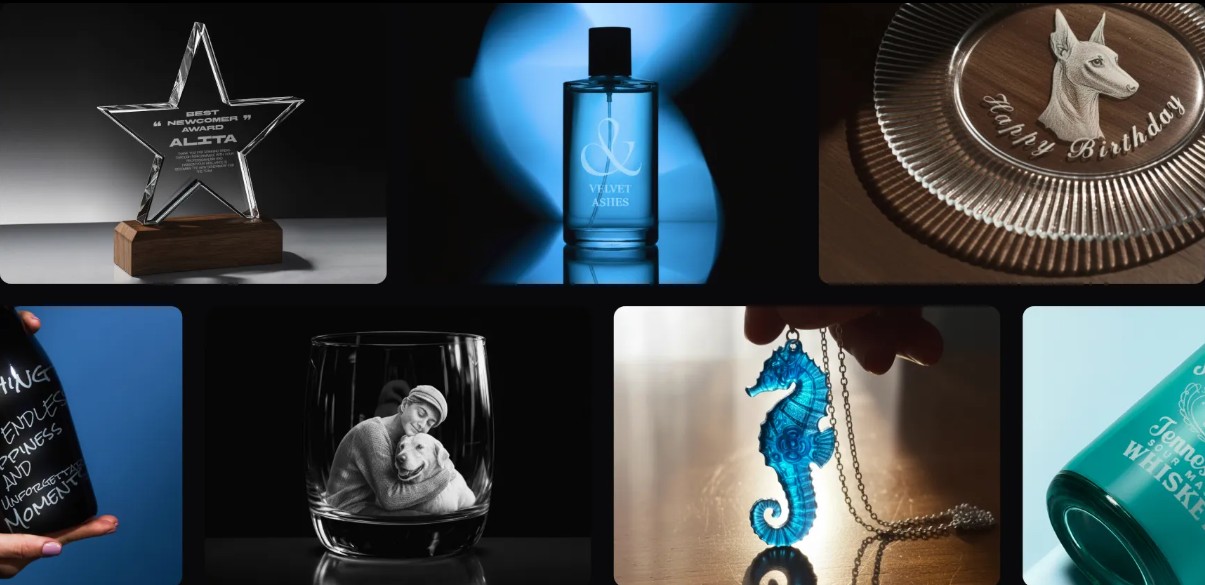
Once cold marking works on your bottle, the same process covers a wider range: cosmetic and skincare bottles and jars, spirits and beverage glassware, and crystal awards for corporate events. It also suits gift and hamper work, where a small mark in the right place turns a standard hamper into something a recipient keeps.
Each of those items is still glass with its own thickness and finish. The bottle you test today becomes the reference for the next one.
Glass varies, so the only honest test is your actual bottle. Send us one (or a few), and we’ll engrave a sample name on it so you can see the finish — clean, permanent, and with no cracking.