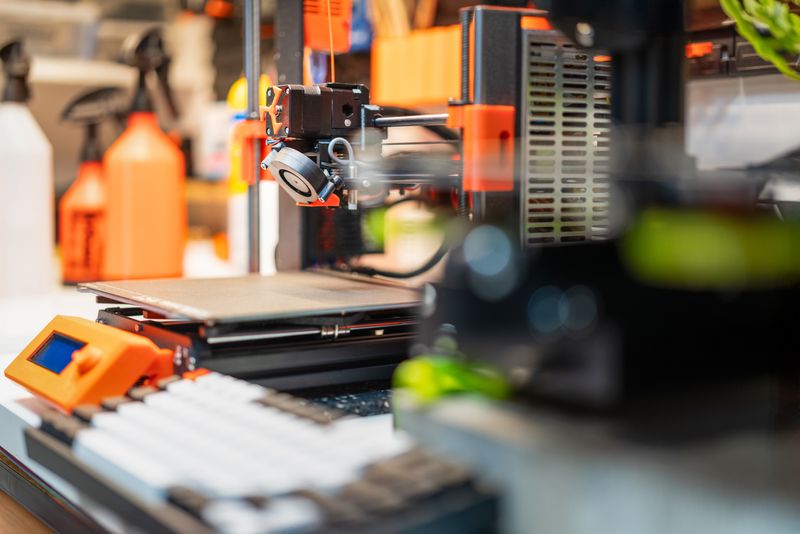
FDM (Fused Deposition Modelling) extrudes melted thermoplastic filament through a heated nozzle, laying down material layer by layer. It is the most common and affordable 3D printing technology — and the most versatile when it comes to materials.
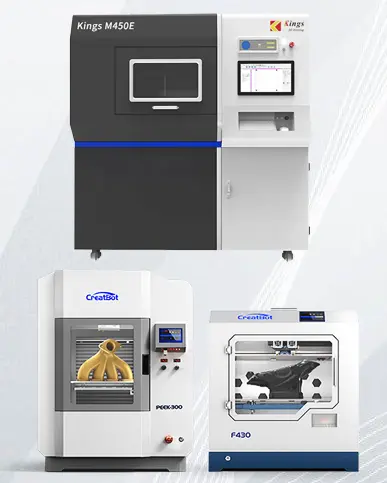
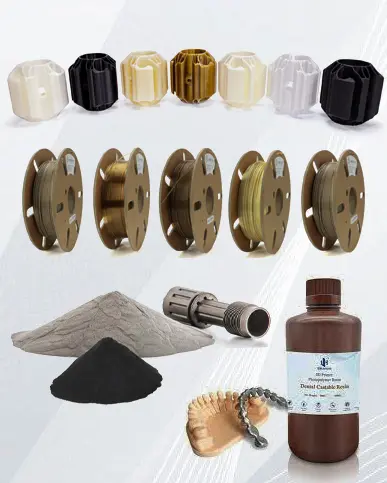
Because FDM melts real engineering plastics, the parts are strong and functional — you can print working prototypes, jigs, fixtures and even production parts. The material choice is huge: from everyday PLA and PETG, to engineering nylon, carbon-fibre-filled polymers, and high-temperature PEEK and ULTEM.
Machines we recommend: the Bambu Lab A1 Mini for beginners, the Bambu Lab X1 Carbon for prosumer work, and the CreatBot D600 Pro2 HS for industrial production.
Resin printing (SLA / DLP / MSLA) uses light to cure liquid photopolymer resin into solid layers. Because the light can be focused far more precisely than a nozzle, resin prints achieve much finer detail and smoother surfaces — often indistinguishable from injection-moulded parts.
The trade-off is materials and workflow. Resin parts are more brittle and less heat-resistant than FDM, and every print needs washing and UV-curing before it is usable. But for detail-critical work, nothing else comes close.
Machines we recommend: the Soonser Mars Pro for budget entry, the E-Plus EP-A800 for professional SLA, and the WaxJet 510 for castable jewellery patterns.
| Factor | FDM | Resin (SLA/DLP/MSLA) |
|---|---|---|
| Surface finish | Visible layer lines | Smooth, near-moulded |
| Detail resolution | 50–300 microns | 25–50 microns |
| Part strength | Strong & functional | Brittle, lower impact resistance |
| Heat resistance | High (PEEK up to ~250°C) | Low to moderate |
| Materials | PLA, PETG, ABS, nylon, carbon-filled, PEEK, ULTEM | Photopolymers: standard, tough, flexible, castable, dental |
| Build volume | Up to 1 m+ (large format) | Smaller (typically under 300 mm) |
| Post-processing | Minimal (remove supports) | Wash + UV cure (essential) |
| Running cost | Low (filament RM 50–200/kg) | Higher (resin + IPA + curing) |
| Safety | Low (ventilation for some filaments) | Moderate (resin is a skin irritant) |
| Best for | Functional parts, jigs, large prototypes | Detailed models, dental, jewellery, miniatures |
The sticker price is only part of the story. Running costs and post-processing equipment add up quickly, especially with resin.
| FDM | Resin | |
|---|---|---|
| Printer (entry) | RM 1,000 – 5,000 | RM 1,500 – 8,000 |
| Printer (professional) | RM 15,000 – 300,000+ | RM 15,000 – 30,000 |
| Consumables | Filament RM 50–200 / kg | Resin RM 150–500 / L |
| Extra equipment | None essential | Wash station + UV curing unit |
| Typical cost per part | Low | Moderate |
If you are buying your first machine or making functional parts, start with FDM — it is cheaper, safer and more forgiving. Add a resin printer when you have a clear need for detail-critical work like dental, jewellery or display models.
Many of our customers run one of each: an FDM machine for day-to-day functional printing, and a resin machine for the high-detail jobs. That combination covers almost every application in Malaysia.
Which is cheaper to run, FDM or resin?
FDM is cheaper — filament is inexpensive and there is no mandatory wash/cure step. Resin adds resin, isopropyl alcohol and a curing station to the running cost.
Can resin parts be used functionally?
Some “tough” or “engineering” resins can handle light functional use, but resin parts are generally more brittle and less heat-resistant than FDM engineering plastics.
Is resin printing dangerous?
Uncured resin is a skin irritant and should be handled with gloves in a ventilated area. Once parts are fully washed and cured, they are safe to handle.
Looking for the right solution for your application? Our team is here to help. Talk to our 3D solution specialist today.
Thank you for signing up. You will be the first to know the Industry news, upcoming products, latest technology and special promotion.
Stay Tuned.