Robotic Welding vs Manual Welding: Where Each One Wins
Robotic Welding vs Manual Welding: Where Each One Wins
Quick verdict: manual welding wins on flexibility — one-offs, awkward positions, site work, jobs that change every hour. Automated welding wins on repetition — the same joint, the same fit-up, the same torch angle, hour after hour, with the arc on more of the time and a record of every pass. The most productive shops in Malaysia increasingly run both: the cobot takes the long, boring, repeat passes, and the welder’s skill goes where it decides the result.
Welding is where the cobot conversation stops being theoretical. A welder is a craftsman whose skill took years to build, and the work around that skill — re-positioning, tacking to a fixture, running the same 300 mm seam for the fortieth time this week — is exactly the work that should not consume it. Meanwhile the fabricator’s real problems are familiar: a shortage of skilled welders, work that must be re-done, and arc-on time that never reaches the number the quotation assumed.
This article is the honest comparison. Not “robots are better” — credible welders know that is nonsense — but where each approach genuinely wins, and how the two fit together on a Malaysian shop floor. For the commercial picture of a welding cobot cell, see our cobot welding solution.
What a welding cobot actually does
Strip away the marketing and a welding cobot is three capabilities bolted to a torch:
It holds an angle. Torch angle, travel speed and stick-out stay inside the window that produces a good bead — not because the robot is smarter than the welder, but because it never gets tired, distracted or rushed. On repeating joints, this is where robotic welds earn their reputation for consistency.
It moves the part or the torch through a repeatable path. Hand-guide the arm through the seam once, save it, and every subsequent part gets the same motion. Multi-pass work — the long seams that eat a welder’s productivity — is where this shows up most.
It works with the welder, not instead of them. The skilled judgement — reading the puddle, tuning the process, deciding the sequence, fixing the fit-up — stays human. What leaves the welder’s plate is the iteration, not the craft: see the Elfin-Pro class of arms used in these cells, and the Elfin for the value line.
Where manual welding still wins
A cobot that cannot pay for itself on a job is worse than no cobot. Manual welding keeps these jobs, and the list is longer than vendors admit:
One-offs and prototypes. Setup for a repeat weld takes minutes; manual work starts immediately. When the part never repeats, the setup cost is the whole cost.
Field and site work. Welding in position on an installed structure, in a yard, up a ladder — the environment manual welders dominate and robots do not enter.
Awkward geometry in low volume. If the joint can only be reached from one strange angle, and there is one part to weld, manual hands (and eyes) win.
Fit-up problems that need judgement. A wide gap or a distorted assembly is a decision, not a path. Welding cobots work best where the joint is at least consistent; the welder handles the rescue work.
Very small total welding hours. If the shop welds two hours a day, automation arithmetic cannot work — and it should not be forced.
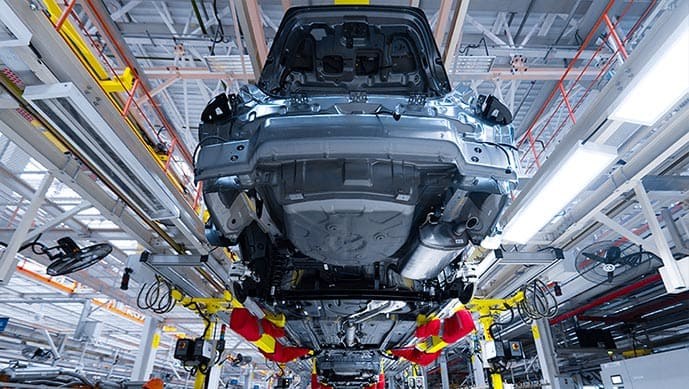
Automotive welding: the classic repeat-work case — the same joint, thousands of times.
The comparison, side by side
Manual welding
Welding cobot
Consistency on repeat joints
Varies with fatigue and shift
Same torch angle and speed every pass
Arc-on time
Interrupted by positioning, rework and rest
The arc stays on through the batch
Flexibility
Any geometry, any location, immediately
Repeat work; changes need re-teaching
Setup overhead
Near zero for one-offs
Fixtures and teaching before the batch
Skill dependency
Bound to the welder available that day
Quality not hostage to the roster
Environment
Heat, fumes, sparks, discomfort
Operators out of the arc, supervising
Documentation
By inspection and memory
Every pass logged if required
Best for
One-offs, field work, repair, prototypes
Repeat parts, long seams, batch production
Process coverage: MIG, TIG and laser
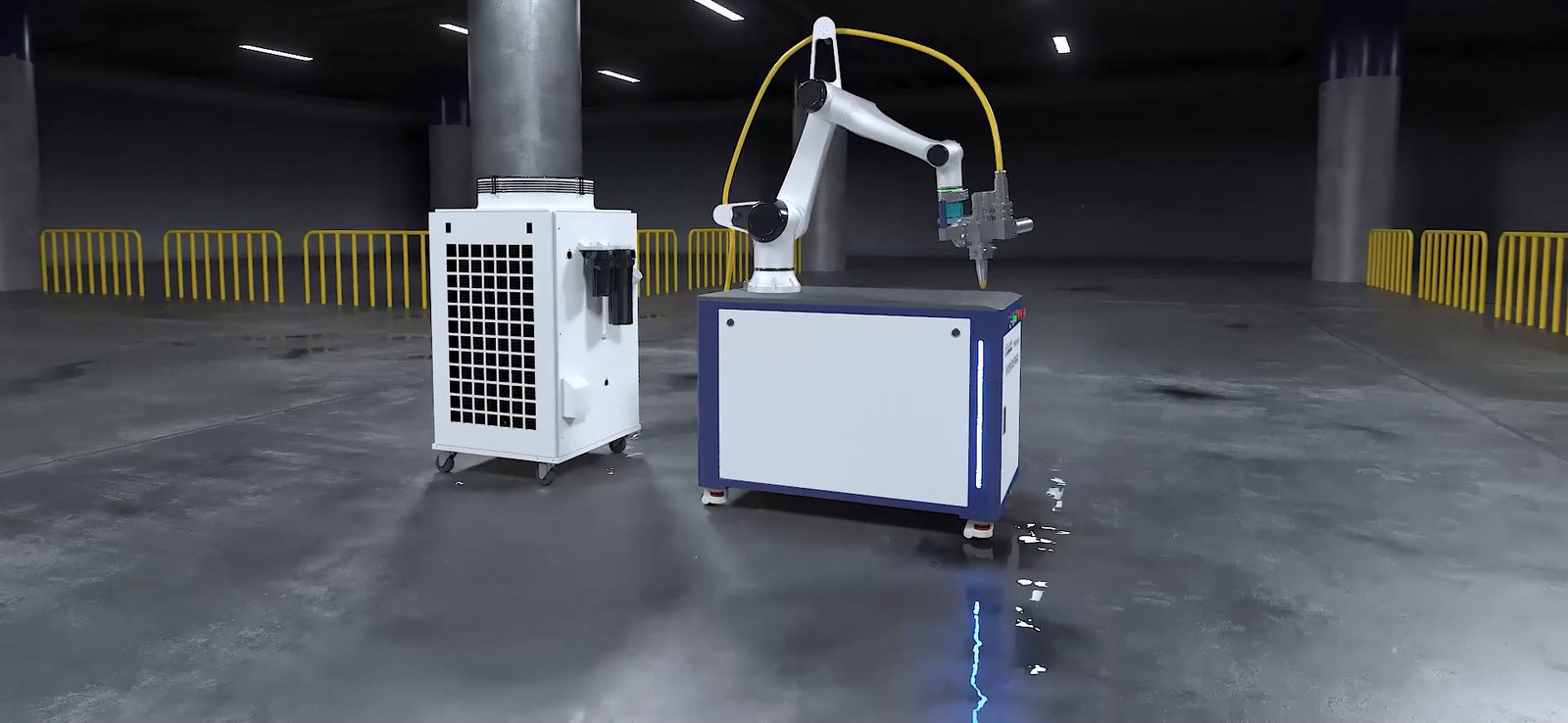
Collaborative welding cells in our projects follow the torch package: MIG for the bulk of fabrication work, TIG where the quality or the material calls for it, and laser welding for the fine, fast, low-heat work where a precise arm is the point. The arm is the same class of robot; the process lives in the torch, the source and the fixture — which is why the right question is never “can a cobot weld?” but “can this joint be fixtured to repeat?”
The other end of the spectrum: structures that never repeat, welded in position.
The hybrid that usually wins
In practice the strongest shops split the work by nature of the job, not by technology:
The cobot gets the long seams and the repeat parts — the 300 mm runs, the multi-pass cycles, the batch of identical frames.
The welder gets the judgement work — fit-up, tacking, the tricky positions, the repair table, the parts the cobot just finished so they can move to the next job.
Teaching happens by hand-guiding — the welder shows the arm the path directly, which is why the person who knows the weld quality is also the person who can improve the program.
This is also the answer to the labour question. Not “one robot replaces N welders” — that arithmetic never survives contact with a real weld — but “the welders you have produce more good work, and the fourth welder you could not hire is no longer the constraint.”
What decides the case on your floor
How much of the welding repeats? Walk the shop and separate the joints into “same as yesterday” and “never seen before”. The first pile is the candidate.
What is the arc-on time today? Positioning, cleaning, tacks and walking between jobs usually dominate the day. A cell changes that ratio before it changes the welding speed.
What does rework cost? If defects trace back to fatigue on long runs, consistency is the payback — not speed.
Who is available to weld next year? The skilled-welder pipeline is the industry’s hardest constraint; capacity that does not depend on hiring is capacity you can promise.
Frequently asked questions
Can a cobot weld as well as a skilled welder? On a repeatable joint, its consistency often exceeds what a tired human holds across a shift — that is the point of it. On judgement — fit-up, distortion, unexpected geometry — the skilled welder is irreplaceable, which is why the productive pattern is the hybrid above, not replacement. Ask any honest integrator for a weld test on your joint before believing anything either way.
Does it need special fixtures or tables? It needs the joint to repeat: a fixture or positioner that presents the part the same way each cycle. Manual welding tolerates variation that a cobot cannot see; good fixture design is where most of the reliability is bought. Existing jigs often form the starting point, with positioners added where the work needs rotating.
Which process is best for a collaborative cell? Follow the joint, not the fashion. MIG dominates general fabrication; TIG where quality or material demands; laser for fine, fast, low-distortion work. The arm handles all three through the torch package and the safety configuration.
What about safety — arc flash, fumes, burns? A welding cell is assessed like any operation: fume extraction is part of the design rather than an afterthought, the arc is screened, and the operator’s position is planned to keep them out of the flash even while supervising. The collaborative arm’s own force limits are one ingredient; the welding hazards are managed by the cell design around it.