
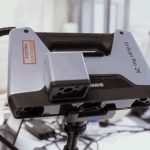
Handheld 3D scanner with robotic arm for automated data capture
3D Scanning Solutions by Industry in Malaysia
3D Scanning Solutions by Industry in Malaysia Quick verdict: Whatever your industry — automotive, mold...
3D scanning for education and research
3D Scanning for Education & Research in Malaysia
3D Scanning for Education & Research in Malaysia Quick verdict: For universities, polytechnics and...

3D scanning an infant's head for a cranial helmet
3D Scanning for Medical, Dental & Orthotics in Malaysia
3D Scanning for Medical, Dental & Orthotics in Malaysia Quick verdict: For orthotics, prosthetics...

3D scanning an energy pipeline for corrosion inspection
3D Scanning for Energy & Heavy Equipment Inspection in Malaysia
3D Scanning for Energy & Heavy Equipment Inspection in Malaysia Quick verdict: For energy operators...

No posts found
  • Article
  • >
  • Reverse Engineering & 3D Inspection Software in Malaysia (Scan to CAD Guide)

Reverse Engineering & 3D Inspection Software in Malaysia (Scan to CAD Guide)

Reverse engineering scan to CAD

Quick verdict: For manufacturing teams in Malaysia, the real value sits in two software workflows: reverse engineering — turning a 3D scan into an editable CAD model with EXModel — and 3D inspection — comparing a scanned part against its CAD model with SHINING3D Inspect or PolyWorks Inspector. Here is how each works and which one your team needs.

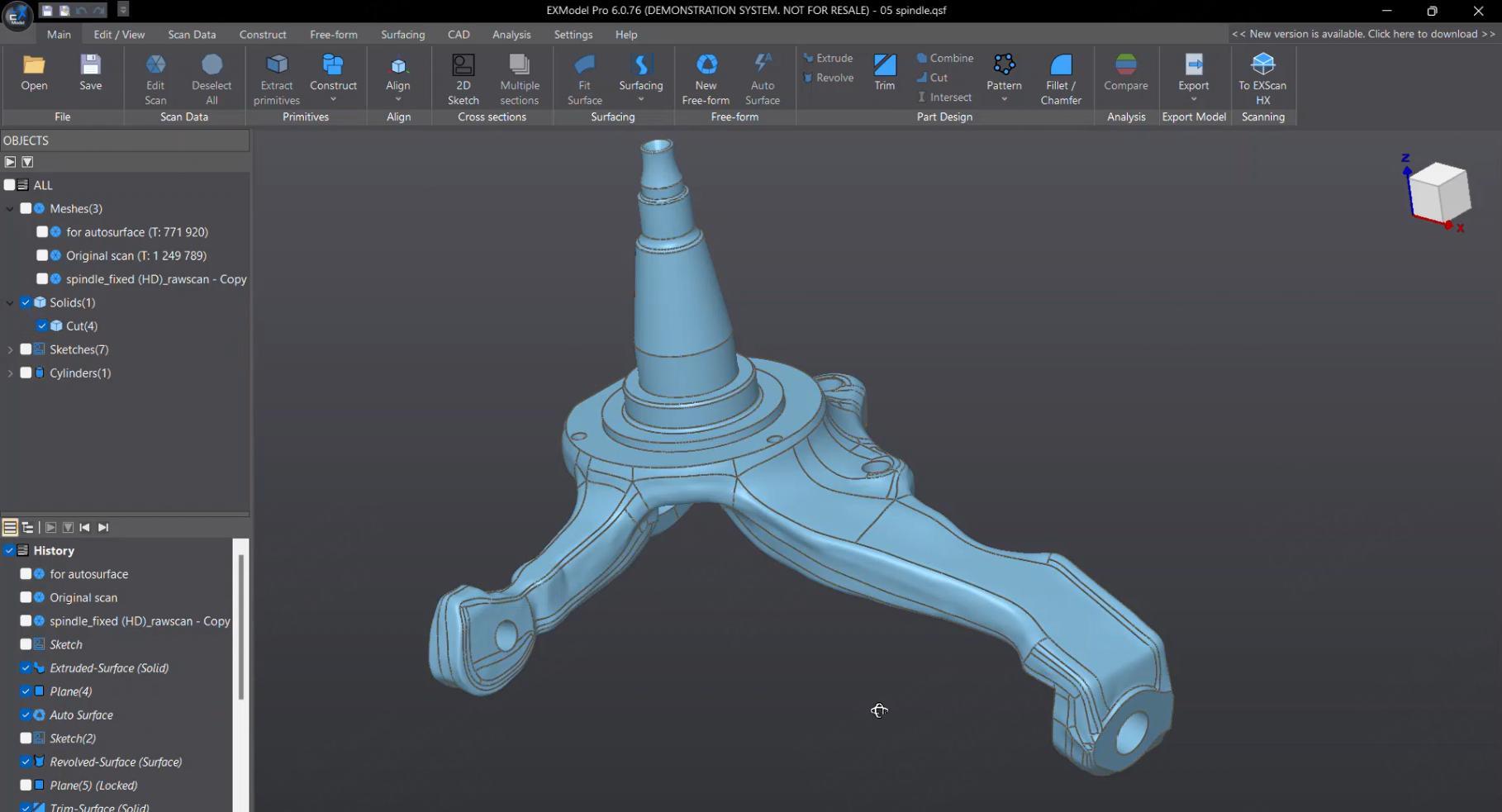
Reverse engineering: scan to CAD with EXModel

Reverse engineering starts with a 3D scan of an existing part, then turns that scan into an editable CAD model. The scan alone is only a mesh — to modify, manufacture or redesign it, you need scan-to-CAD software.

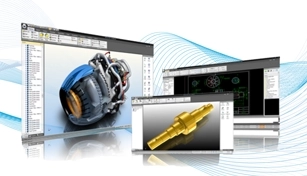
EXModel is the dedicated bridge: it converts mesh data into professional-grade, parametric CAD in a few steps. Pair it with a scanner like the EinScan Libre and the mesh transfers into EXModel in one click via EXScan — a seamless scan-to-CAD workflow.

EXModel Pro adds the full reverse-engineering toolkit: Class-A surfacing, hybrid free-form/parametric modelling, advanced filleting and full feature-tree transfer to mainstream CAD packages.

EXModel scan to CAD software

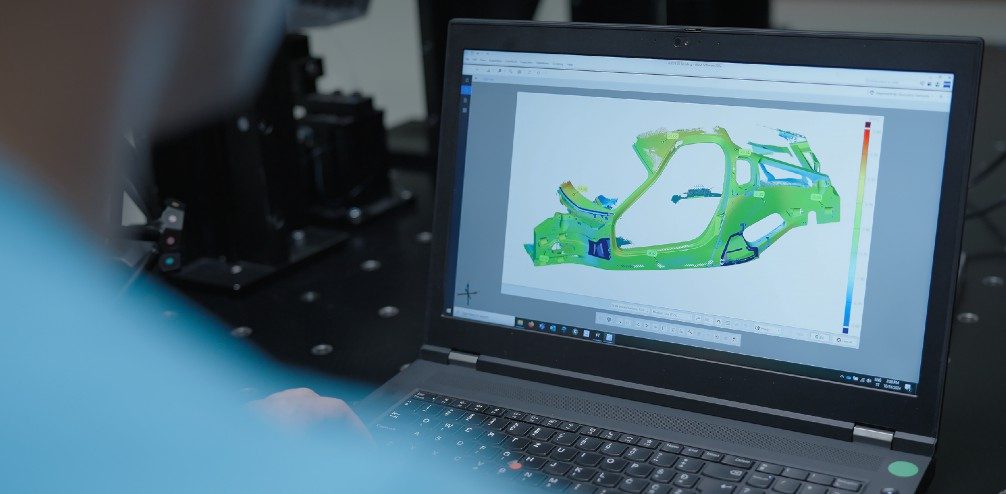
3D inspection: compare parts against CAD

3D inspection workflow

Inspection is the other half of quality control. A 3D scanner captures the produced part, and inspection software overlays it onto the original CAD model to produce a colour-mapped deviation report showing exactly where the part is in or out of tolerance.

SHINING3D Inspect and PolyWorks Inspector are the mainstream tools here — both fully compatible with Shining 3D scanners. They handle CAD comparison, GD&T checks and automated reporting, turning quality control from manual guesswork into a documented, traceable workflow.

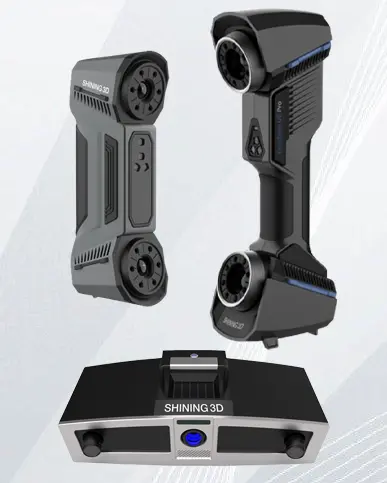
For high-accuracy, small-part inspection, pair the software with a desktop scanner like the OptimScan Q12 or a wireless handheld metrology scanner like the FreeScan Combo+ Wireless.

EXModel vs EXModel Pro

Feature EXModel EXModel Pro
Mesh editing & alignment Yes Yes
Cross sections / 2D & 3D sketching Yes Yes
Auto surfacing / free-form modelling Yes Yes
Class-A surfacing (loft, sweep, fill, blend) Yes
Advanced filleting, flatten, roll/unroll Yes
Hybrid parametric + free-form modelling Yes
Feature-tree transfer to other CAD Yes

Which software for which job?

Choose scan-to-CAD (EXModel) when…

  • You need to recreate or modify an existing part
  • Original CAD files are lost or unavailable
  • You are doing aftermarket or legacy-part work
  • You want editable parametric CAD from a scan

Choose inspection software when…

  • You need to verify parts against a design
  • You require GD&T and tolerance checks
  • You want documented, traceable reports
  • You do batch quality control

Malaysia-specific considerations

  • Hardware + software bundle — the scanner and the software work as one solution; confirm your vendor supplies both and trains your team on the workflow.
  • Licensing — check whether the software is perpetual or subscription, and how many seats your team needs.
  • File formats — make sure the software exports STEP / IGES for your CNC or 3D printer downstream.
  • Training — reverse engineering and inspection software have a real learning curve; vendor training shortens it considerably.

Our honest recommendation

If your workflow starts from an existing part, invest in a handheld 3D scanner plus EXModel Pro for scan-to-CAD reverse engineering. If you are checking production parts, add SHINING3D Inspect or PolyWorks Inspector to turn scanning into a documented quality-control loop. Read our 3D scanning guide to plan the full workflow.

FAQ

What is the difference between EXModel and EXModel Pro?
EXModel covers the core scan-to-CAD workflow; EXModel Pro adds Class-A surfacing, hybrid modelling, advanced filleting and full feature-tree transfer to other CAD packages.

Do I need reverse engineering or inspection software?
Reverse engineering (EXModel) recreates a part in CAD from a scan; inspection software verifies a produced part against its CAD model. Many teams use both.

Which software works with Shining 3D scanners?
EXModel / EXModel Pro for reverse engineering, and SHINING3D Inspect or PolyWorks Inspector for inspection — all fully compatible with Shining 3D scanners.

Can I get a trial of EXModel?
Yes — Shining 3D offers a 30-day free trial so you can test the scan-to-CAD workflow before buying.

Need help choosing?

Bring a sample part and we will run a live scan-to-CAD or inspection demo, then recommend the right scanner + software bundle for your accuracy and budget. Contact Trinventor Solution today.

Thank you for signing up. You will be the first to know the Industry news, upcoming products, latest technology and special promotion.

Stay Tuned.