Palletizing Robot & Automatic Palletizing Solution Malaysia
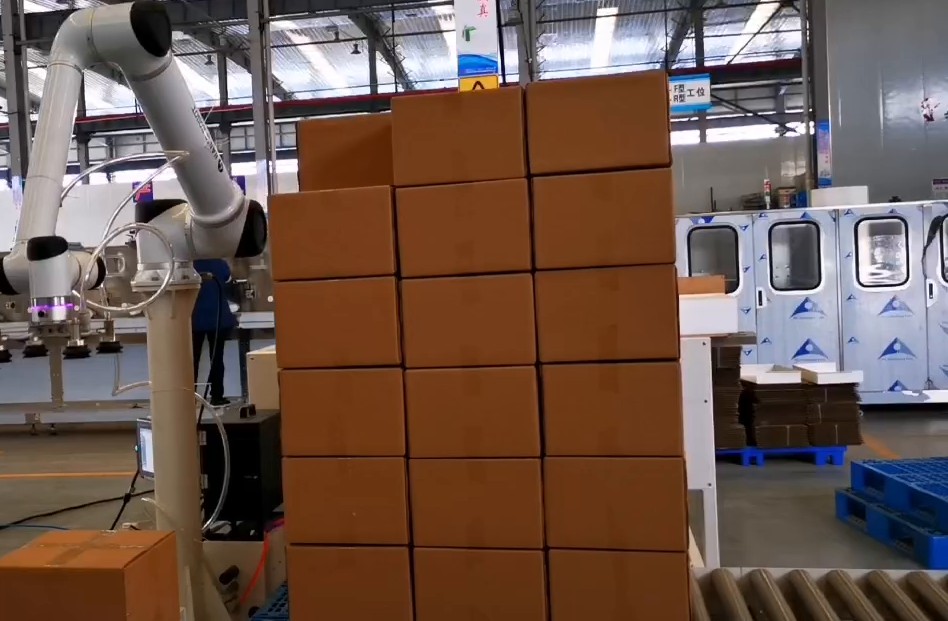
A palletizing cobot building a carton stack: the arm places every case to the same pattern, so the pallet that leaves the line is built the same way every shift
Quick verdict: robot palletizing earns its place when the same cases or bags go onto pallets all day and the end of your line is where people get worn out or hurt — not when every pallet is a new pattern and nothing repeats. Tell us your pattern mix before anything else; it decides whether palletizing automation is the right answer and how simple the cell can stay.
Palletizing is the last job on the line and the one most likely to be done by whoever is left: heavy, repetitive, and judged by how the load arrives at the customer. A palletizing robot does that job to the pattern every time — cases square, layers level, nothing leaning — while the people who were stacking move to work that needs them.
Trinventor Solution supplies and integrates Huayan collaborative robots for palletizing in Malaysia — the S Series heavy payload line (20–60 kg) for cartons, bags and drums, and the Elfin-Pro arm for lighter boxes at bench-side cells. As the authorized distributor we scope the whole cell: gripper, pattern teaching, in-feed, pallet handling, safety and after-sales support. This page covers where robot palletizing fits, how the cell is built, and which robot suits which load.
When robot palletizing pays off
End-of-line stacking is the classic automation case because the work never varies in the way that matters — the same product arrives in the same case, and the same case goes onto the same pallet:
The same pattern runs repeatedly. One or a handful of pallet patterns covers most of your output, and they are already written down or can be documented in an afternoon.
Two or three shifts of stacking. Stacking a full line by hand, all shift, is how backs and shoulders go — and how you end up short-staffed on the night shift.
Cases or bags are heavy. Between roughly 20 and 60 kg per case is where manual palletizing stops being sustainable and where the S Series payload range starts.
Load quality matters. A squared, consistent stack travels better, gets rejected less at the customer, and is safer for whoever unloads it.
The line should not stop when a person does. The robot stacks through breaks, shift handovers and the last hour of the day — the boring hours where mistakes happen.
Where it does not fit: pallets that are genuinely different every time, one-off loads, or a line whose output is too low to keep an arm busy. In those cases the honest answer is a pallet table and better lifting aids, and we will say so at the assessment.
The palletizing cell we set up
In-feed. Cases arrive from your line or a conveyor to a defined pick position — label up, seal checked, gap controlled. Everything downstream depends on the case being where the robot expects it.
Gripper and payload. The gripper is chosen for the load, not the robot: vacuum for cartons, clamps for unwrapped cases, magnetic for steel drums and pails, bag grippers for sacks. Gripper weight counts against the robot’s payload — we size for it.
Pattern and programming. The pallet pattern is taught and stored: layer by layer, with the pallet size, stack height and slip sheets. When the product changes, the operator recalls the pattern — no re-teaching, no programming background.
Pallet out. The cell signals when the pallet is complete, and the full pallet is taken away by forklift or pallet truck; the empty pallet position or dispenser feeds the next one. Stretch wrapping sits after this point, either manual or its own machine.
Which robot for which load
Payload is set by the case or bag plus the gripper, and reach decides how many pallet positions one arm can serve. As a rule of thumb, size for around 80 % of the rated payload — the arm should never be the thing that limits the cell:
The top of the range: the heaviest sacks, drums and dense loads
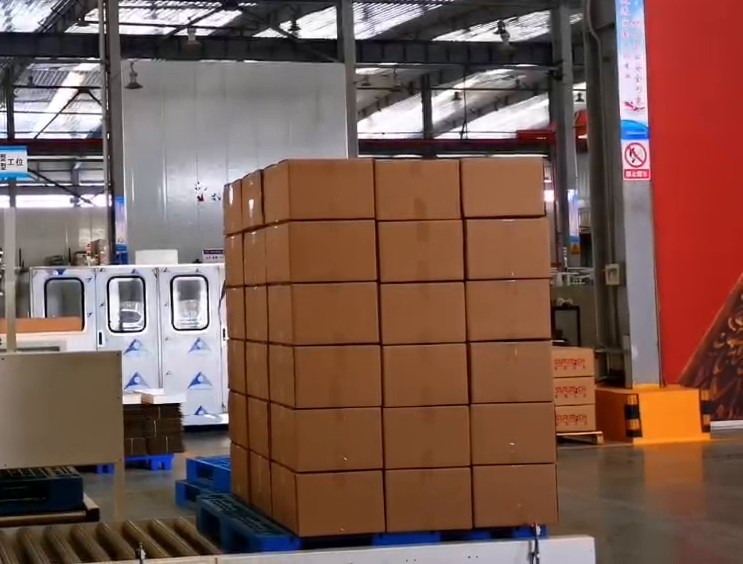
Pallet in, pallet out: the cell sits between the in-feed conveyor and the pallet position, so changeover is a pallet swap, not a rebuild
The gripper decides the cell
The robot is the easy part; the end effector is where a palletizing cell succeeds or fails:
Vacuum grippers — sealed cartons and boxes; fastest for clean cardboard, needs a flat top surface.
Clamp grippers — unwrapped cases, trays and packs that a vacuum cannot hold.
Magnetic grippers — steel drums, pails and metal parts on layer pads.
Bag grippers — sacks and woven bags, which need support under the load rather than suction on it.
Tell us the load and the pattern and this list collapses to one gripper. If the load changes later, the gripper can change with it.
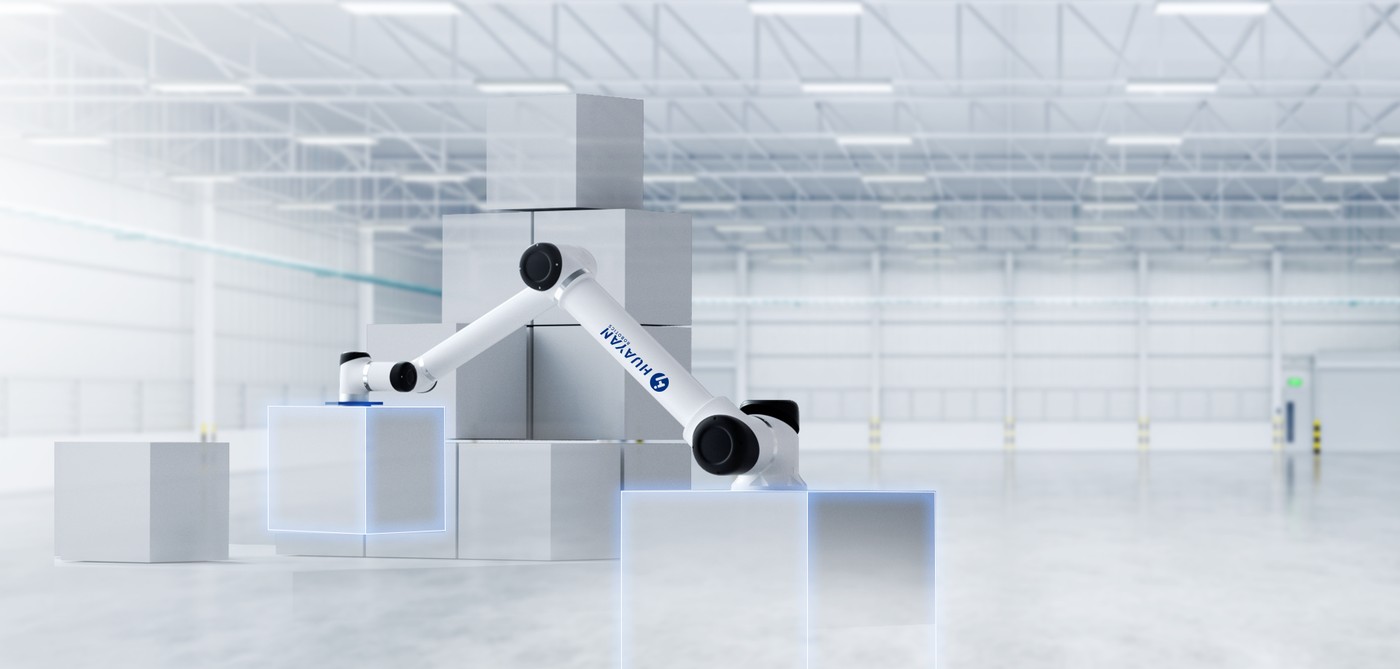
Sizing is a working-envelope question as much as a payload one: the arm has to cover the pick point, every pallet position and the full stack height without reaching its limits
Safety and layout
A palletizing cobot is built for work alongside people — the safety basis is ISO 10218-1 and ISO 10218-2, with ISO/TS 15066 covering collaborative operation. The practical questions are about the traffic around the cell:
Pallet removal. Forklifts and pallet trucks come and go from the cell all day, so the operator interface and pallet positions are laid out to keep people out of the arm’s working envelope when a pallet changes.
Light curtains and area scanners where the line must stay open to the floor — typically across the pallet positions rather than a full fence around everything.
Load stability. Stack height, pattern and slip sheets are part of the cell design, because a leaning stack is a safety issue the day after installation.
What we set up for you
We are the authorized distributor for Huayan robotics in Malaysia, and a palletizing cell is a system, not a robot. The scope we quote covers:
Assessment — whether palletizing automation pays off for your patterns, and which loads to start with
Demo — your case or bag, palletized before you commit
Integration — gripper, in-feed interface, pallet positions and safety layout
Installation — on your floor, with handover on your patterns
Programming — every pattern taught and stored with its SKU
Training — your operators recalling patterns and running the cell
Spares — gripper wear parts and consumables kept local
Service contract — scheduled support so the line keeps running
What we need from you for a quote
Prices are quoted per cell, because two palletizers with the same arm can be very different projects once the gripper, in-feed and pallet handling are counted. To quote accurately we need:
The case or bag: dimensions, weight, and how it is sealed
The pallet patterns you run, and the pallet size and stack height
Output: cases or pallets per shift you need to move
How the line presents the product, and how full pallets leave today
The space around the end of the line — forklift traffic, clearances, floor
Frequently asked questions
How much does a palletizing robot cost in Malaysia?
We quote per cell, and the robot is rarely the biggest line item — the gripper, in-feed interface, pallet handling and safety scope decide the number as much as the arm does. That is why we do not publish a price list: one line needs a vacuum gripper and a conveyor interface, another needs a bag gripper and a pallet dispenser. Send us the case and the pattern and we will scope the total solution against your output; if the volume does not justify a robot, we will tell you that instead of quoting.
How fast can a palletizing robot run?
The rate depends on the pattern, the case weight and how far the arm travels — not on a headline figure from a brochure. The S Series joint speeds are high for their class, but the honest way to answer is to cycle-test your pattern: give us the case and pallet layout and the demo produces a real number for your product. Most lines are limited by their in-feed, not by the robot.
Can one robot handle several products and patterns?
Yes — patterns are stored per SKU and recalled by the operator, so the same cell can run carton A in the morning and bag B after lunch with a change of gripper where needed. The practical limit is how different the loads are: everything on vacuum is easy, while mixing cartons and 50 kg drums in one cell usually deserves a second look at which arm covers both.
Does a palletizing cobot need a safety fence?
Not a full fence as standard. Collaborative arms are designed for work alongside people, and the guarding is planned around the actual risks — usually light curtains or area scanners across the pallet positions and a defined path for forklift traffic. The risk assessment is done with you on your layout; it decides the guarding, and we build to ISO 10218-1, ISO 10218-2 and ISO/TS 15066.
Do we need to buy the gripper and conveyor from you?
We supply the complete working cell, including the gripper and the interface to your in-feed, because a robot without a proven end effector is a demo. If you already run conveyors you want to keep, we integrate with them; if you are starting from scratch, the cell scope covers everything from the pick position to the pallet out.
What about stretch wrapping and pallet handling?
Stretch wrapping sits after the palletizing cell and can stay manual, or become its own machine as volumes grow — the cell signals when a pallet is complete either way. Empty and full pallets move by forklift or pallet truck, or by pallet dispenser where the rate demands it. We plan that flow with you so the robot is never waiting on an empty pallet.
What support do we get after installation?
Local support from Kuala Lumpur: gripper wear parts and spares held locally, service contracts with scheduled support, and trained people who know your cell and your patterns. Training, spares and service are all part of the quoted scope.
Talk to our team
Send us your case, bag or drum — a photo with dimensions is enough to start — and we will tell you whether robot palletizing fits your patterns, what the cell would look like, and what the total solution involves. Contact Trinventor Solution for a live demo, consultation and local after-sales support in Malaysia.