Where 3D scanning fits in teaching and research
Printing produces a part. Scanning does the opposite: it turns a physical object into data that can be measured, compared against a CAD model and rebuilt. In a teaching or research setting that closes the loop — students can design a part, print it, scan it back and prove how far the printed result sits from the design.
Three uses come up repeatedly. The first is metrology teaching: dimensional inspection, GD&T and tolerance analysis, done on the same class of instrument that industry uses rather than on a toy. The second is reverse engineering coursework, where an existing component has to be measured and turned into a CAD model. The third is collection work — dental and anatomy specimens, engineering artefacts, museum or archive items — where the object must be recorded without being touched, and where colour often matters as much as shape.
What we would use, and why
| What you need to do | What we would use | Why that one |
|---|
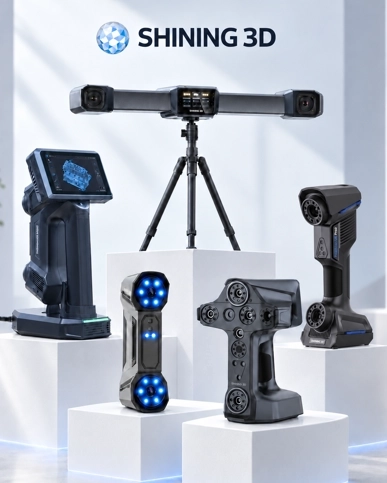
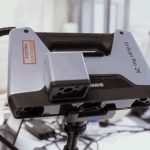
| Teach dimensional inspection, GD&T and tolerance analysis | FreeScan Combo+ Wireless | Metrology-grade handheld — 0.02 mm, ISO 10360 acceptance tested — so students learn on the instrument they will meet at work |
| Reverse engineering coursework: part to CAD model | EinScan Rigil | Tri-mode professional scanner that runs standalone or with a PC — hard to misuse, and it pairs with scan-to-CAD software |
| Digitise specimens, artefacts and archives in colour | EinScan Libre | Colour and texture are captured with the geometry, non-contact, which is what makes it suitable for fragile or one-of-a-kind objects |
| Repeat measurement of small precision parts in a lab | AutoScan Inspec2 | Automatic desktop scanning at 0.01 mm class — one click per part, so results do not depend on who is operating it |
| Set up a scanning lab and train staff | Installation, onboarding and training | We commission the system on your own parts and train the people who will use it, then stay available for application support |
| Run a one-off research project without buying equipment | Our 3D scanning service | Quoted per project — the sensible route when the need is occasional, or before committing a budget |
Outputs are the same as industry work: mesh files (STL, OBJ, PLY) for printing and visualisation, CAD-ready STEP or IGES after reverse engineering, colour scans, and measured dimensions or inspection reports where the point is to prove a result. See what a project delivers and the wider picture on 3D scanning by industry.
Practical notes for institutions
Equipment is quoted per configuration rather than from a list price, because a teaching lab and a research group need different things: how many people will use it, whether it has to move between rooms, what software the course requires, and whether results must be traceable. Tell us the course or the research question and we will quote against it, and say plainly if a service project would serve you better than a purchase.
Support is part of what you buy. Installation, onboarding, application guidance and technical training are all handled locally in Malaysia, so a scanner does not become a cupboard item after the first semester.
Frequently asked questions
Which scanner suits a teaching lab?
It depends on what is being taught. Dimensional inspection and tolerance analysis call for a metrology handheld; design and reverse engineering coursework suits a professional tri-mode scanner that students cannot easily misconfigure; specimen and heritage work calls for colour capture.
Can we scan delicate specimens without damaging them?
Yes. Scanning is non-contact — nothing touches the object, and no spray or marking is needed for most materials.
Do students need specialist training to use it?
The acquisition side is guided and largely automatic, and we train your staff and students on your own parts during commissioning. Inspection software is the part that needs teaching, and that is where the local support matters.
Can you digitise a museum or departmental collection?
Yes — artefacts, models, dental and anatomy specimens, engineering components. Where appearance matters, colour and texture are captured with the geometry.
How is equipment for a school or university quoted in Malaysia?
Per configuration, against the course or research requirement rather than from a headline number. Tell us the intended use, how many will operate it and what the output has to be, and we will quote on that basis.
What happens after purchase?
Installation, onboarding, application guidance, troubleshooting and technical training — locally, in Malaysia.