Amnovis Expands US Operations: What 3D Printed Medical Devices Mean for Manufacturers
Amnovis Expands US Operations: What 3D Printed Medical Devices Mean for Manufacturers
Quick verdict: Amnovis, a Belgian metal additive manufacturing firm, built itself a second production base in the United States during 2025, minutes away from Warsaw, Indiana. The acquisition is not the interesting part. The operating model behind it is: print, machine and finish orthopaedic implants in one validated shop, under one quality system, on two continents.
This article covers what Amnovis has built, why that particular corner of Indiana was chosen, how patient-specific implants are actually produced, why titanium dominates the material list, and why the same device needs a separate approval in the United States and in Europe. If you supply medical manufacturers, run a clinic or a dental lab, or you are weighing up a metal 3D printer for regulated work, the process and regulatory detail below is where the value sits. The same questions decide whether 3D printed medical devices are made in-house, bought from a bureau, or left alone.
What happened, and why it reads as recent history
Amnovis is a Belgian additive manufacturing company specialising in metal implants. In 2025 it expanded into the United States, acquiring the additive manufacturing business of Westconn Precision Technologies and setting up a new operations unit in North Webster, Indiana. North Webster sits a short drive from Warsaw, the city that has shaped the world’s orthopaedic supply chain for decades.
The company also named Chris Cook to lead the operation as General Manager of US Operations, with Jake Marasco joining as Account Manager. Neither detail is dramatic. Both say the same thing. This is intended to run as a commercial production unit from day one, not as a sales office with a European parent.
Why Warsaw, Indiana carries so much weight
Warsaw is where two of the largest orthopaedic implant makers in the world keep their headquarters, surrounded by an unusually dense network of component suppliers, precision machine shops, toolmakers, coating specialists and testing houses. That cluster did not appear by accident. Orthopaedic manufacturing rewards proximity, because designers, surgeons, production engineers and regulatory staff have to solve problems together on short cycles.
For a company arriving from Europe, the density is the product. People with metal implant experience already live there. Customers are within a short drive. Subcontractors for heat treatment, finishing and inspection sit on the same estate or the next town along. A plant plugged into that environment can qualify for commercial work far faster than one built on a greenfield site, because the surrounding supply chain already understands medical manufacturing.
What Amnovis moved across the Atlantic
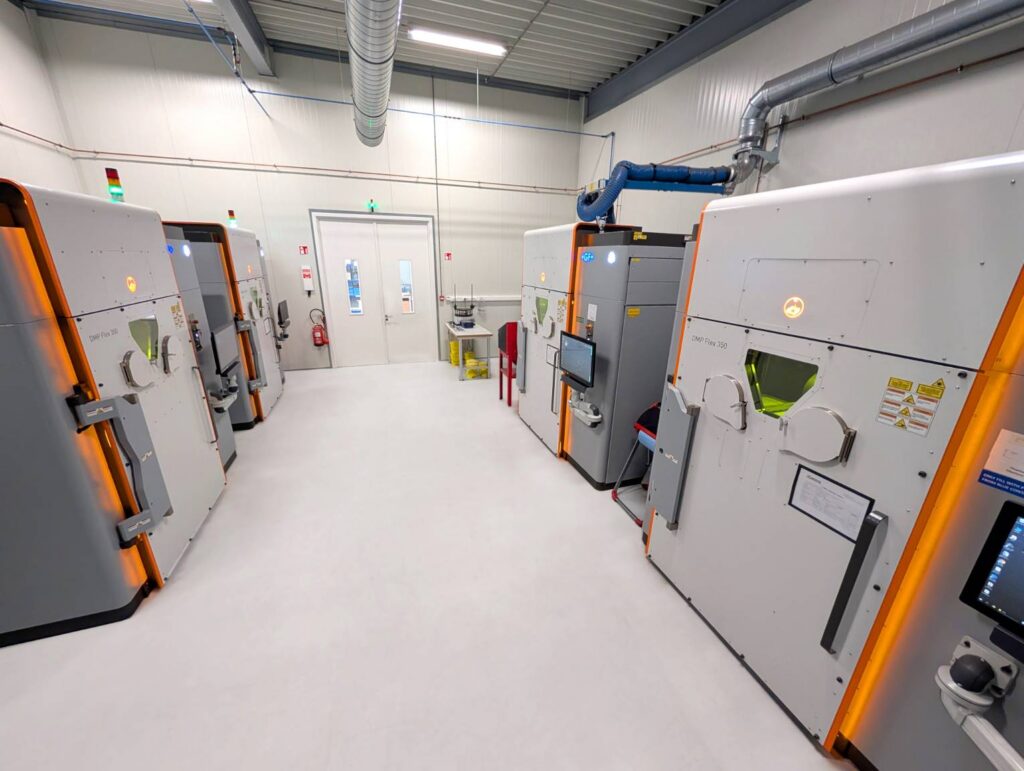
In Europe, Amnovis runs as a vertically integrated partner for orthopaedic development: design for additive manufacturing, printing, post-processing and regulatory submission handled in-house. Its core process is laser powder bed fusion (L-PBF) of metals, with the emphasis on titanium spinal implants and other load-bearing structures that depend on complex lattice geometry.
The United States site reproduces that model. Printing, CNC machining and electrical discharge machining (EDM) all happen on-site, governed by the same quality management systems that the Belgian headquarters operates under. That combination matters more than it may sound. Machining and EDM are how a printed implant becomes a finished implant, because that is where support structures come off, where threads and mating surfaces are cut to tolerance, and where fine features a laser cannot hold are wire-eroded afterwards.
A service bureau that can only print ships green parts. Its customer then has to find a machine shop able to handle an unfinished titanium medical component, qualify that shop, and own the handover. Keeping those steps under one roof removes the problem, and it removes it inside the same quality system that governs the printing.
Patient-specific implants, and why printing is the sensible way to make them
A standard implant comes in sizes. The surgeon picks the closest match and adapts the procedure around it. A patient-specific implant is designed around one patient instead. A CT or MRI scan is converted into a three-dimensional model, the defect or bone surface is defined in CAD software, and the device is shaped to that geometry, usually with fixation points planned to line up with the screws the surgeon intends to place.
Additive manufacturing makes this economic. A machined custom implant needs programming, fixturing and tool access, and some of the shapes surgeons ask for cannot be cut at all. A printed part is built from a digital file, so the cost of a change is mostly design time rather than new tooling.
The same freedom allows structures that were never machinable: open lattices and porous surfaces that bone can grow into, and stiffness that can be tuned across a part so it shares load with the surrounding bone instead of shielding it. That last point explains why spinal cages and hip components were among the first implants to move to metal printing.
Time-critical work is the other half of the argument. A revision case after an infection cannot wait on a tooling programme, and the shorter path from scan to finished device is the whole point of printing a custom component. That means the printing step is rarely the bottleneck. Finishing, inspection and sterilisation decide when the device reaches the operating theatre, which is why the machining and EDM capacity matters as much as the printers.
Why titanium and other medical materials suit additive manufacturing
Implant materials are chosen for the body first and the process second, but a small number of alloys happen to print well.
Material
Typical implant use
Why it works with powder bed fusion
Titanium alloys (Ti-6Al-4V and its ELI grade)
Spinal cages, hip stems, bone plates, dental components
Biocompatible, corrosion resistant and strong for its weight. Titanium powder also fuses well in a controlled atmosphere, so lattice and porous structures can be built in one piece
Cobalt-chrome
Bearing surfaces in knee and hip replacements, dental frameworks
Hard and wear resistant. Printing to near-net shape wastes less of an expensive alloy as swarf than cutting from bar
Stainless steel 316L
Trauma plates and screws, surgical instruments
Ductile, well documented for medical use, and familiar to both machine shops and regulators
Radiolucent and closer in stiffness to bone. Usually produced by high-temperature material extrusion or machining rather than metal printing
Two process details decide whether a metal build is implant-grade. The first is the powder. Particle size distribution, chemistry and reuse history all affect the finished part, so a medical shop tracks powder batches and sets reuse limits rather than topping up indefinitely. The second is atmosphere. Titanium reacts with oxygen and nitrogen at melting temperature, so the build happens inside a sealed chamber filled with inert gas, with oxygen kept low, and the machine is cleaned thoroughly between materials to prevent cross-contamination.
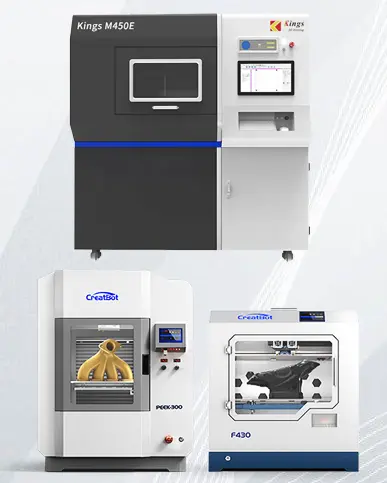
For an engineer in this region, both points translate into questions worth asking any equipment supplier: how much powder handling does the machine require, how is the atmosphere controlled, and what does the manufacturer document for medical users. Below the industrial scale, compact metal systems such as those in the SLM metal 3D printer range now make it possible to prototype implant geometries and run process trials locally before committing to anything larger.
Why US and EU approval are two separate projects
Both jurisdictions regulate implants strictly, and both expect a validated quality system, documented processes, material traceability and clinical evidence. They differ in who reviews the evidence.
Aspect
United States (FDA)
European Union (MDR)
Who reviews the submission
The regulator itself
An accredited notified body, with the national competent authority supervising the market
Usual route for an orthopaedic implant
Clearance by showing substantial equivalence to a device already on the market, or a premarket approval application for the highest-risk devices
Conformity assessment leading to CE marking, supported by technical documentation and a clinical evaluation
Manufacturing site
Registered and inspected, with the quality system audited
Same, plus notified body audits and unannounced visits
Process changes
May trigger a new submission
Handled through the quality system, with notified body approval
What a supplier with two sites removes
Repeating supplier qualification for the same processes, and the risk of two vendors running slightly different process baselines
US clearance also travels well. Regulators in many other countries, including several in Asia, treat a US clearance or a European CE mark as a reference point when reviewing their own submissions, which shortens their assessment. That is one reason a partner able to support both routes at once is attractive to a device maker selling internationally.
Fragmentation is the real cost. A manufacturer qualifying a printed implant in Europe already carries the surveillance burden of a notified body. Selling into the United States adds a second set of submissions written to a different structure, a second supplier qualification exercise and a second audit trail to keep current. When one supplier holds both sites under one framework, much of that duplication falls away, and a change made in Belgium is easier to mirror in Indiana.
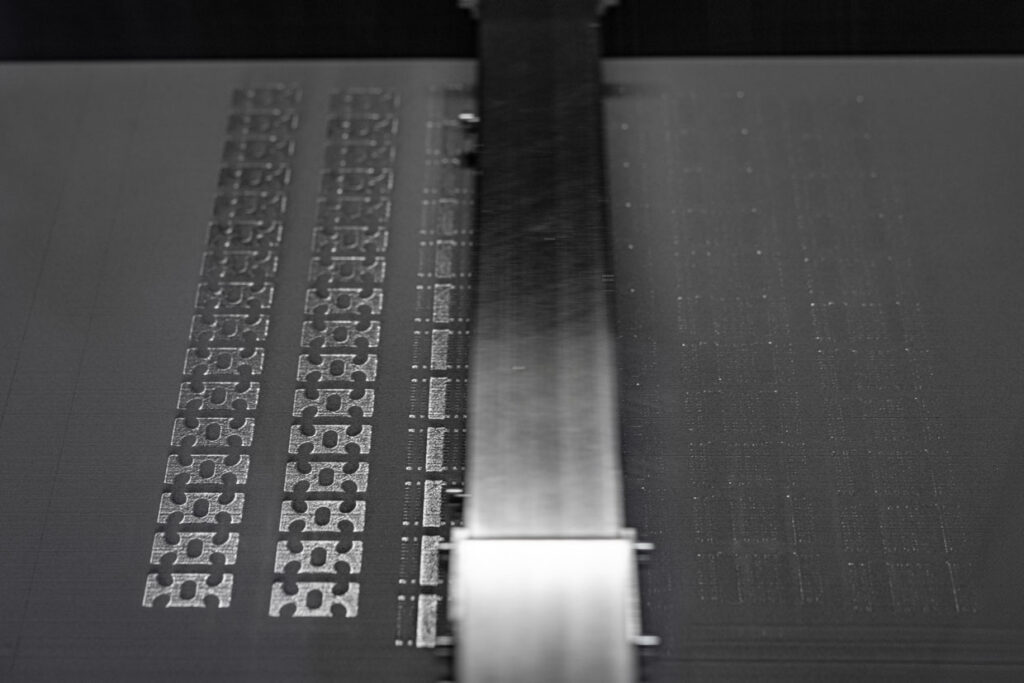
A finished implant like this one is the sum of several processes: the printed lattice, the machined interface where it meets its fixation hardware, the surface treatment that prepares it for bone contact, and the inspection records that follow it into surgery. Put all of that under a single quality system and a device maker can qualify the whole route once instead of assembling it from four suppliers. That is the capability the Warsaw move is really about.
What this means for manufacturers and clinics in this region
Few readers of this site will build a metal implant plant. The useful lessons still travel.
Qualification is the product. Amnovis is not selling machine time. It is selling a validated system that a device maker can put its own name on. Any local shop moving towards medical work should budget for documentation, traceability, calibration and process control before it budgets for a bigger machine.
Print and finish in one place. Printed parts only become saleable once they are machined, cleaned and inspected. Metal printing without downstream finishing capability leaves you supplying green parts on somebody else’s schedule.
Scanning is the front end. Patient-specific work starts with imaging data that has to become an accurate CAD model. Reverse engineering and inspection software, such as the tools in the reverse engineering solution range, is what turns a scan into a design and a finished part back into verifiable data.
Know where your entry point is. Implant-grade metal printing needs a controlled facility, powder handling, inert atmosphere, heat treatment, finishing and a quality system that a regulator inspects. Most local capacity will be added first in resin printing for anatomical models and surgical guides, high-temperature FDM for instruments and fixtures, and metrology scanning for verification.
For clinics, the takeaway is simpler. Two qualified manufacturing sites running one quality system means a supply that is harder to interrupt, and a shorter route for a custom device from scan to surgery. Supplier selection becomes a question about validated processes and audit history rather than about a brochure.
For anyone building capability in this field, the direction is clear. Work on 3D printed medical devices flows to the shops that can document a process, and only afterwards to those that can run a machine.
In Malaysia, the Medical Device Authority is the regulator that devices must satisfy before they reach patients, and hospitals buying implants depend on a registered, traceable supply chain. That requirement is what makes the dual-site model relevant here rather than a curiosity in Indiana.
Frequently asked questions
What is laser powder bed fusion?
A laser traces each layer of a part into a bed of fine metal powder, fusing the powder where material is needed. The build plate drops, a fresh layer is spread, and the process repeats until the part is complete. Implants are usually built in titanium or cobalt-chrome, then machined and finished.
What makes an implant patient-specific?
It is designed from that patient’s own imaging rather than chosen from a size range. A CT or MRI scan becomes a digital model, the surgeon and engineer settle the design, and the device is made to fit that anatomy, often with screw positions planned in advance.
Why titanium rather than stainless steel?
Titanium is biocompatible, resists corrosion inside the body and offers a better strength-to-weight ratio, which matters in a spinal or hip implant that carries load for years. It also prints well as powder, so lattices and porous surfaces can be built into the part as it is made.
Does FDA clearance also cover the European Union?
No. They are separate approvals with separate reviewers. A US clearance is often used as a reference point by regulators elsewhere, and a CE mark carries similar weight, but each regulator assesses the device against its own rules.
Can a Malaysian workshop print implants for local hospitals?
Not for implanted parts. That path needs a validated metal system, controlled powder handling, heat treatment, machining and finishing capability, and a quality system the regulator has cleared. What local labs and clinics can do now is print anatomical models and surgical guides in resin from patient scans, and use 3D scanning for inspection and fit checking. The DLP and MSLA printer range covers the resin side, and the 3D inspection solutions cover the verification side.