ABS 3D Printing: A Complete Guide to Material Properties, Settings, and Best Practices
ABS 3D Printing: A Complete Guide to Material Properties, Settings, and Best Practices
ABS (Acrylonitrile Butadiene Styrene) is one of the most widely used engineering thermoplastics in fused deposition modeling (FDM) 3D printing. Known for its toughness, impact resistance, and relatively low cost, ABS has been a cornerstone material in both industrial and desktop 3D printing for decades. From the iconic LEGO building blocks to automotive trim components, ABS has proven itself as a durable material suited for functional end-use parts rather than purely aesthetic prototypes.
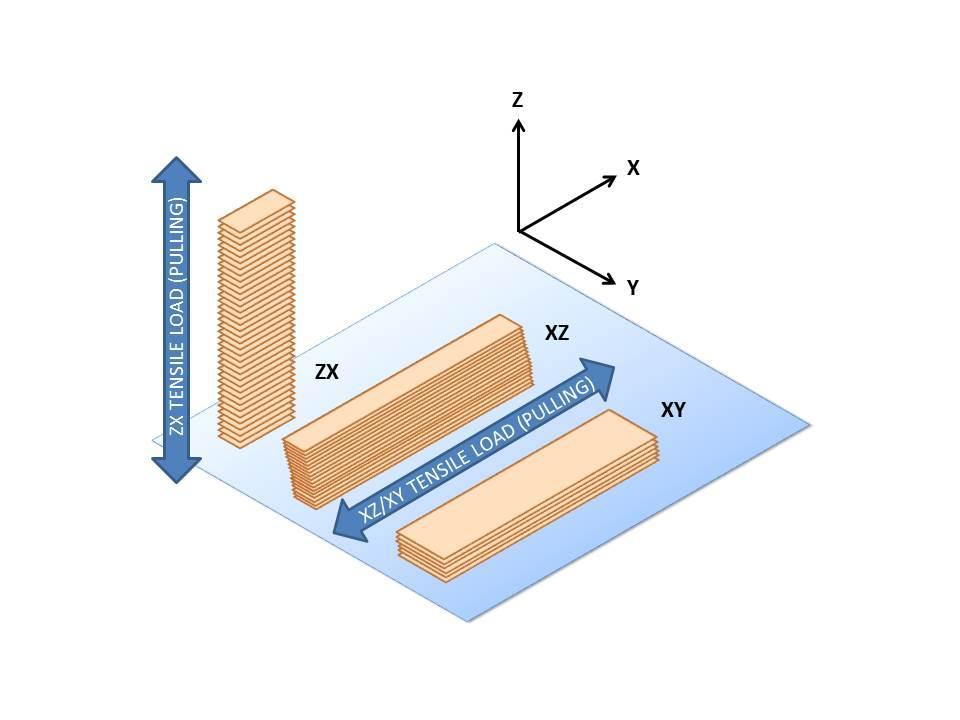
Part orientation on the print bed determines how layers are aligned within a 3D printed ABS part, directly affecting strength and dimensional accuracy along different axes
This guide covers everything you need to know about ABS 3D printing: its material properties, how it compares to other common filaments, best printer settings, common challenges and how to address them, and the applications where ABS excels.
What is ABS 3D Printing Filament?
ABS is a thermoplastic polymer composed of three monomers: acrylonitrile, styrene, and butadiene. Each component contributes distinct properties to the final material. Acrylonitrile provides rigidity, strength, and chemical resistance. Styrene gives ABS its characteristic smooth and shiny surface finish. Butadiene — the rubbery component — delivers the toughness and impact resistance that makes ABS parts durable under stress and repeated use.
ABS was first patented in 1948 and quickly became one of the most widely used engineering plastics across industries including automotive manufacturing, consumer electronics, and construction. Its adoption in 3D printing followed naturally as the technology matured, with ABS becoming the de facto standard material for FDM systems once consumer-grade printers became widely available.
Unlike PLA, which is biodegradable and derived from plant-based sources, ABS is a petroleum-based thermoplastic that is not biodegradable. However, it can be recycled, and recycled ABS is commonly processed into sheets, trays, and automotive components.
ABS Material Properties
ABS offers a distinctive combination of mechanical and thermal properties that make it suitable for demanding applications:
Impact resistance: ABS absorbs energy effectively under sudden loads, outperforming PLA and PETG in impact strength tests (200-215 J/m compared to 26 J/m for PLA).
Thermal resistance: With a glass transition temperature around 105°C and the ability to withstand continuous operating temperatures up to approximately 100°C, ABS performs better than PLA in hot environments.
Flexural strength: ABS measures approximately 2400 MPa in flexural strength, significantly higher than PLA (106 MPa) or PETG (70 MPa).
Toughness: The butadiene component gives ABS a rubbery toughness that allows it to flex rather than shatter under load.
Machinability: ABS is easy to drill, sand, and machine post-print, making it suitable for functional prototypes that require additional finishing.
Dimensional stability: ABS expands when heated and contracts significantly as it cools, which requires careful thermal management during printing.
ABS vs Other Common 3D Printing Filaments
Understanding how ABS compares to other popular filaments helps determine when to choose it over alternatives:
ABS vs PLA: ABS is significantly tougher and more impact-resistant than PLA. PLA is rigid and brittle, prone to breaking under sudden loads or cyclic stress. ABS withstands higher temperatures without deforming, making it suitable for outdoor or hot-environment use where PLA would soften. However, PLA is easier to print — requiring no heated chamber and producing no odor — while ABS demands enclosed printing and good ventilation.
ABS vs PETG: PETG offers a middle ground: easier to print than ABS with better layer adhesion and less warping, while maintaining good strength and chemical resistance. However, PETG has lower heat resistance (approximately 80°C ceiling) and is less tough than ABS under impact loading. ABS remains the better choice for high-temperature or high-impact applications.
ABS vs Nylon: Nylon outperforms ABS in toughness, chemical resistance, and abrasion resistance. Nylon is more flexible and absorbs moisture readily, while ABS resists moisture absorption. Nylon requires even higher printing temperatures (250°C) and more stringent moisture control. ABS is generally easier to print than nylon while still delivering good functional properties.
Key ABS Filament Properties at a Glance
Typical mechanical and thermal properties of ABS filament:
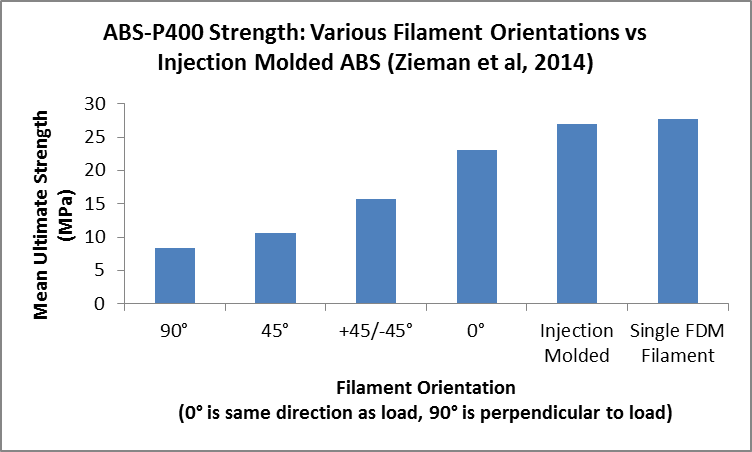
Tensile strength testing demonstrates that orientation perpendicular to the load direction significantly reduces part strength in FDM-printed ABS, making proper part orientation critical for functional applications
Impact strength: 200-215 J/m
Flexural strength: 2400 MPa
Tensile strength: 43 MPa
Elongation at break: 10-50%
Young modulus: 1.79-3.2 GPa
Hardness: Shore D 100
Thermal conductivity: 0.17-0.23 W/mK
Density: 1.03-1.14 g/mL
Best ABS Printer Settings
Printing ABS successfully requires attention to temperature management and build surface preparation. The following settings represent typical starting points:
Extruder temperature: 220-250°C (230-250°C is the most common range; always check the manufacturer’s datasheet for the specific formulation)
Bed temperature: 95-110°C (110°C is recommended to prevent first-layer warping on larger parts)
Print speed: 30-60 mm/s for best quality; printing too fast increases warping risk
Layer height: 0.1-0.2 mm
Part cooling fan: Off or no higher than 30% after the first layer; excessive cooling worsens warping
Retraction settings: 3-6 mm retraction distance at 25 mm/s retraction speed
Wall thickness: Minimum 1.5 mm for functional parts to prevent brittleness
Infill: 20-50% depending on the application; functional load-bearing parts may need 50-80%
Build Surface and Bed Adhesion
Achieving reliable first-layer adhesion is the single most critical factor in successful ABS printing. Common build surface options include:
Kapton tape (polyimide): Applied to a heated glass bed, Kapton tape provides good adhesion and tolerates the high temperatures ABS requires. Clean the surface with isopropyl alcohol before printing.
ABS slurry: A mixture of dissolved ABS filament in acetone applied to the glass bed. When the hot ABS print contacts this slurry, it bonds chemically, creating very strong adhesion. The slurry can be mixed from scrap ABS and acetone, or purchased pre-made.
PEI sheet: A durable build surface that provides good adhesion for ABS when heated. PEI tolerates repeated use and requires minimal preparation.
Glue stick on glass: A simpler alternative using common household glue stick applied to the heated glass bed. Less consistent than other methods but accessible and low-cost.
How to Prevent ABS Warping and Shrinkage
Warping is the primary challenge when printing with ABS. As ABS cools from its extrusion temperature down to room temperature, it contracts significantly — a linear shrinkage of approximately 0.5-0.8% is typical. This contraction causes edges to lift and curl, particularly on the first few layers and with large flat surfaces.
Heated Chamber and Enclosure
The most effective solution for ABS warping is printing within an enclosed heated chamber maintained at approximately 45°C. The chamber prevents rapid cooling of the part during printing, minimizing the temperature gradient that drives warping. Many professional FDM printers include heated chambers for precisely this reason.
If your printer lacks an enclosed chamber, you can construct an enclosure from acrylic panels or cardboard to trap heat around the print. Even simple enclosures significantly reduce warping on most prints. The enclosure also serves a safety function by containing ABS fumes within a controlled space.
Brims, Rafts, and First-Layer Strategies
For large parts or parts with a small footprint, adding a brim or raft dramatically improves first-layer adhesion:
Brim: Prints a wide flat skirt around the base of the model on the first few layers, dramatically increasing the surface area holding the part to the build plate. Fast and material-efficient.
Raft: Prints an entire sacrificial plastic platform beneath the model. The raft absorbs warping forces and provides a perfectly flat first surface. More material-intensive but effective for difficult prints.
First-layer temperature boost: Printing the first 3-5 layers at 10-20°C above the target temperature improves initial layer bonding and reduces separation risk.
Part Orientation and Layer Alignment
Research demonstrates that the orientation of ABS layers relative to applied loads significantly affects part strength. Studies on FDM-printed ABS show that parts printed with filaments oriented at 0 degrees to the load direction perform similarly to injection-molded ABS. Parts printed at other orientations progressively weaken.
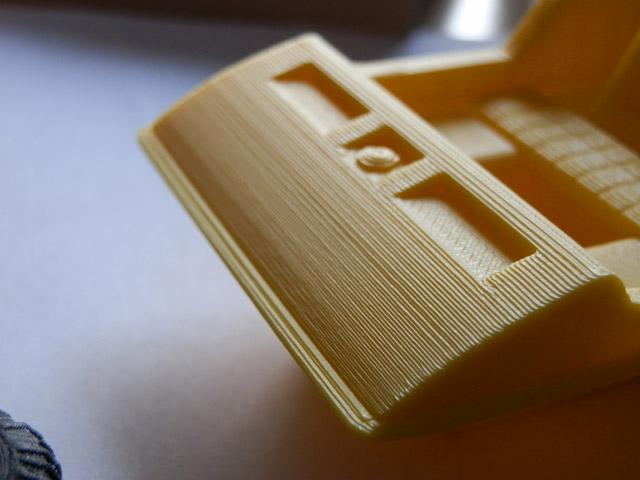
Shallow slopes on 3D printed ABS parts visibly reveal individual layer lines due to the staircase effect, making part orientation critical for achieving desired surface finish quality in visible or cosmetic surfaces
For fatigue-critical applications, research indicates that alternating layers at +45/-45 degree orientations provides better performance than purely unidirectional loading. This cross-ply orientation distributes loads across multiple layer bonds simultaneously.
When designing parts for ABS printing, consider:
Orienting the primary load path parallel to the print bed (XY plane) for maximum strength
Avoiding orientations where layers are perpendicular to the dominant load direction
Accounting for the staircase effect on sloping surfaces — shallow slopes visibly show layer lines and are weaker
Designing parts to avoid thin walls in the Z direction, where layer adhesion is inherently the weakest
ABS Safety: Ventilation and Fume Management
ABS printing produces fumes that include styrene, a compound classified as a potential human carcinogen. Printing ABS in poorly ventilated spaces can result in exposure levels that cause headaches, irritation, and long-term health concerns with sustained exposure.
Essential safety practices for ABS printing include:
Ventilation: Place your 3D printer in a well-ventilated area. If printing indoors, open windows or use an exhaust fan to continuously remove fumes from the printing area.
Enclosure with filtration: Many modern 3D printers include built-in HEPA filtration systems that capture ultrafine particles and reduce fumes at the source.
Exhaust routing: Route printer exhaust through a flexible duct to an exterior window or directly outside. This is one of the most effective ways to eliminate indoor air quality concerns.
Never print unattended in sleeping areas: Do not run ABS prints overnight or in rooms where people sleep without active ventilation or filtration.
Post-Processing ABS 3D Printed Parts
ABS responds well to a variety of post-processing techniques that improve surface finish and enable additional finishing:
Sanding and machining: ABS is easy to sand manually or with power tools. Start with 220-grit sandpaper and progress through 400, 600, and 800 grit for a smooth finish before applying primer or paint.
Acetone smoothing: Exposing ABS to acetone vapor dissolves the outer surface slightly, creating a smooth glossy finish. This technique is effective but requires careful control of exposure time and acetone vapor concentration to avoid part deformation.
Priming and painting: ABS accepts standard spray primers and paints well. Sand between coats and use plastic-compatible primers for best adhesion.
Glue and welding: ABS parts can be joined using acetone as a solvent weld — applying acetone between two ABS surfaces fuses them permanently. Commercial ABS cement or epoxy adhesives also work well.
Common ABS 3D Printing Applications
ABS’s combination of toughness, heat resistance, machinability, and relatively low cost makes it suitable for a wide range of applications:
Functional prototypes: ABS is the material of choice for prototypes that undergo mechanical testing, functional fit checks, and repeated handling. Its toughness means parts survive assembly and test procedures that would shatter PLA prototypes.
Automotive hardware: Interior trim components, mounting brackets, and functional parts under the hood benefit from ABS’s heat resistance and durability. Many aftermarket automotive accessories are injection-molded ABS.
Electronic enclosures: ABS’s electrical insulating properties and ability to be machined make it suitable for housing electronic devices, power tool casings, and consumer electronics.
Tooling and jigs: Custom jigs, fixtures, and manufacturing aids printed in ABS can withstand workshop environments and extended use better than PLA alternatives.
Toys and consumer products: The iconic LEGO brick — made from ABS since 1949 — demonstrates the material’s durability in products subjected to repeated assembly and disassembly by children.
Cosplay and props: ABS is popular in costume and prop making where its toughness, machinability, and ability to be smoothed with acetone make it ideal for detailed functional pieces.
Conclusion
ABS 3D printing remains a cornerstone of functional FDM additive manufacturing. Its superior impact resistance, thermal tolerance, and machinability compared to PLA make it the preferred choice for end-use parts, functional prototypes, and applications where durability matters. The key to successful ABS printing lies in managing its sensitivity to thermal gradients — a heated bed, enclosed print chamber, and deliberate build surface preparation collectively address the material’s warping tendencies.
While ABS requires more attention to ventilation and safety than PLA, the resulting mechanical properties and part durability make the extra effort worthwhile for engineering applications. For anyone moving beyond basic prototyping into functional part production, ABS is an essential material to master.
Thank you for signing up. You will be the first to know the Industry news, upcoming products, latest technology and special promotion.