Powder Bed Fusion 3D Printing: How It Works, Materials, and Applications
Powder Bed Fusion 3D Printing: How It Works, Materials, and Applications
Powder bed fusion 3D printing has become one of the most widely adopted metal additive manufacturing technologies, enabling the production of complex metal parts that would be impossible to manufacture using traditional methods. From aerospace components to dental restorations, PBF technology has matured from a research curiosity into a production-grade manufacturing process capable of producing thousands of parts per year.
The technology works by selectively fusing metal powder layers using either a high-powered laser or electron beam, building parts one cross-section at a time from CAD data. This approach produces fully dense metal parts with mechanical properties comparable to conventionally manufactured components, making PBF suitable for demanding applications in aerospace, automotive, medical devices, and industrial manufacturing.
This guide covers how powder bed fusion works, the different technology variants, key vendors and systems, available materials, and the broad range of applications where PBF has proven its value in production environments.
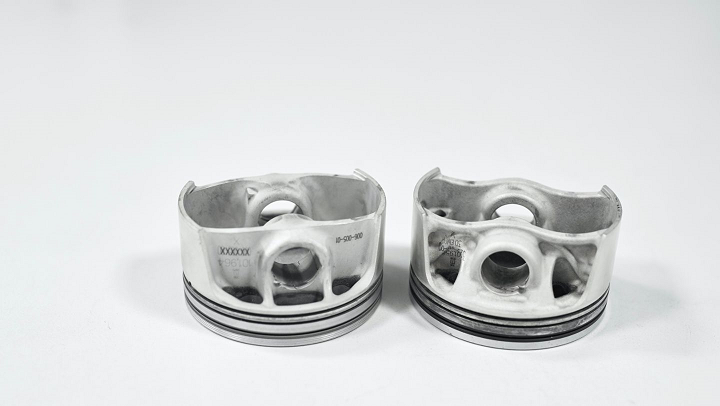
Porsche 3D printed pistons using powder bed fusion technology, achieving 20 percent weight reduction and improved performance compared to traditionally forged pistons in the 911 GT2 RS
How Powder Bed Fusion Technology Works
Powder bed fusion creates metal parts by selectively fusing thin layers of metal powder using thermal energy. The process begins with a CAD model that is sliced into hundreds or thousands of horizontal cross-sections. Each cross-section becomes a layer typically ranging from 20 to 50 microns in thickness.
The build chamber is filled with metal powder and heated to just below the melting point of the material being printed. A recoater blade spreads a thin layer of powder across the build platform, and the energy source (laser or electron beam) traces the cross-section pattern, heating and fusing the powder where the part geometry requires it.
After each layer is fused, the build platform lowers by one layer thickness and the process repeats. Support structures are generated automatically to anchor overhanging features to the build plate or previous layers, and these supports are later removed during post-processing.
The entire process occurs in a controlled atmosphere, either an inert gas environment for laser systems or a vacuum for electron beam systems. This prevents oxidation and ensures consistent material properties throughout the build.
Laser-Based Powder Bed Fusion Systems
The most common form of powder bed fusion uses high-powered lasers to melt metal powder. Several competing terminology standards exist for what is essentially the same core technology, which has led to some confusion in the industry.
Selective Laser Melting (SLM), Direct Metal Laser Sintering (DMLS), LaserCusing, and Laser Metal Fusion (LMF) all refer to laser-based PBF systems. While technically different in whether they fully melt or sinter the powder, modern systems achieve full density and the terms are often used interchangeably in practice.
Laser-based systems use fiber, disk, or CO2 lasers typically ranging from 100 to 1000 watts, with multi-laser configurations becoming common in production systems to increase throughput. The lasers are directed by galvo mirrors that can reposition the beam rapidly across the powder bed, allowing efficient coverage of each layer regardless of part geometry.
argon or nitrogen gas maintains a low-oxygen atmosphere in the build chamber, preventing oxidation of the molten metal. Gas flow systems continuously remove smoke and spatter generated during the melting process, maintaining good beam-powder interaction throughout the build.
Electron Beam Melting Technology
Electron beam melting (EBM) uses a high-energy electron beam instead of a laser to melt metal powder. The electron beam is generated by heating a tungsten filament and accelerating electrons through a potential difference of 60 to 80 kilovolts. Magnetic coils focus and direct the beam across the powder bed.
EBM operates in a high vacuum environment, which eliminates oxidation concerns entirely and allows reactive metals like titanium to be processed without special atmosphere control. The vacuum also enables efficient beam deflection at high speeds, potentially offering advantages in scan strategy flexibility.
The main difference between EBM and laser-based PBF involves the powder bed temperatures and cooling rates. EBM operates at higher powder bed temperatures, typically 700 to 1000 degrees Celsius for titanium alloys, which reduces thermal stress and often eliminates the need for stress relief heat treatment. However, this also produces larger grain structures in the as-built material.
EBM parts typically have rougher as-built surfaces compared to laser-based systems due to the higher processing temperature and the nature of electron beam-powder interaction. For some applications, this surface roughness is acceptable, while others may require post-process machining to achieve final specifications.
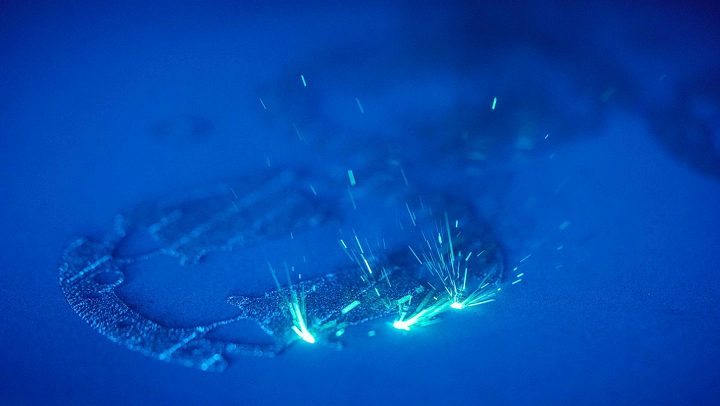
Laser metal fusion uses a high-powered laser to melt metal powder in a controlled inert gas environment, creating dense, fully dense metal parts with mechanical properties comparable to wrought materials
Key Powder Bed Fusion Vendors and Systems
The PBF market includes a mix of established industrial equipment manufacturers and newer entrants focused on specific market segments. Understanding the vendor landscape helps when evaluating PBF systems for specific applications.
EOS GmbH
EOS of Germany is the largest vendor in the laser-based PBF space, with a comprehensive portfolio ranging from entry-level systems to production-focused multi-laser machines. The EOS M 400 Quad with four lasers offers large build volumes and high throughput for volume production applications. EOS has established a strong reputation in aerospace and medical device manufacturing through consistent performance and extensive process qualification documentation.
GE Additive
GE became a major PBF player through acquisitions, purchasing both Concept Laser and Arcam. Concept Laser machines became widely used in dental applications, while Arcam’s EBM systems dominate the orthopedic implant market. The combination gives GE additive capabilities across both laser and electron beam technologies. GE’s resources have accelerated development of the next generation Additive Manufacturing machines targeting high-volume production environments.
SLM Solutions
SLM Solutions of Germany focuses exclusively on selective laser melting technology, with the SLM 500 being their flagship multi-laser production system. The company has made significant engineering advances in layerWise technology and has one of the largest installed bases in the aerospace sector. SLM Solutions is considered one of the top three PBF vendors globally alongside EOS and GE Additive.
Other Notable Vendors
Trumpf offers both laser metal fusion and laser metal deposition systems, leveraging their expertise in laser technology and industrial automation. Additive Industries developed the modular MetalFab1 system designed for automated production environments, sold primarily to aerospace customers including Airbus. 3D Systems acquired Phenix to enter the metal PBF market with their ProX DMP series. More recent entrants like Xact Metal target the entry-level segment with lower-cost systems designed to make PBF more accessible.
Powder Bed Fusion Materials
PBF materials span a broad range of metals, with titanium alloys dominating medical and aerospace applications while stainless steel, tool steels, and aluminum serve industrial manufacturing needs.
Titanium Alloys
Titanium Ti-6Al-4V is the most widely used PBF material, valued for its excellent strength-to-weight ratio, corrosion resistance, and biocompatibility. The alloy is used extensively in aerospace structural components, turbine engine parts, and medical implants. PBF Ti-6Al-4V achieves mechanical properties that typically exceed ASTM and AMS specifications for conventionally manufactured material.
Other titanium grades available for PBF include pure titanium for biomedical applications where the alpha-beta microstructure provides optimal bone ingrowth characteristics, and specialty alloys like Ti-6Al-7Nb for medical devices requiring specific property combinations.
Cobalt Chrome
Cobalt chrome molybdenum alloys are the standard material for dental and orthopedic implants. The alloy provides excellent biocompatibility, corrosion resistance, and wear properties required for long-term implant applications. PBF cobalt chrome achieves fine microstructure and smooth surfaces that make it suitable for dental restorations and joint replacement components.
Stainless Steel and Tool Steels
Stainless steel grades including 316L and 17-4 PH are widely used in PBF for industrial applications, tooling, and functional prototypes. Tool steels like H13 and M2 provide the hardness and wear resistance needed for injection molding inserts and manufacturing tooling. The ability to print tool steels enables conformal cooling channels that improve injection molding cycle times and part quality.
Aluminum and Superalloys
Aluminum alloys including AlSi10Mg provide lightweight options for automotive and aerospace applications where weight reduction matters. Nickel-based superalloys like Inconel 625 and Inconel 718 offer excellent high-temperature performance for turbine engine components, rocket engines, and heat exchangers. These materials are notoriously difficult to machine conventionally, making PBF particularly valuable for complex geometries in these alloys.
Powder Bed Fusion Applications
PBF applications span multiple industries where the combination of complex geometries, high-performance materials, and production-scale volumes provides advantages over traditional manufacturing methods.
Aerospace and Aviation
The aerospace industry was among the first to adopt metal PBF for production parts, driven by the need to reduce component weight while maintaining structural integrity. PBF is used for brackets, housings, ducting, and structural components in both commercial and military aircraft. GE has qualified PBF parts for use in LEAP and GE9X turbofan engines, demonstrating the technology’s maturity for safety-critical aviation applications.
Satellites and rocket engines also benefit from PBF, with the technology enabling lightweight geometries that reduce launch weight and improve performance. The vacuum processing capability of EBM is particularly valuable for titanium aerospace components.
Automotive Manufacturing
Automotive applications for PBF have expanded rapidly, particularly for high-performance vehicles where the technology enables weight reduction and performance optimization. Porsche’s 3D printed pistons for the 911 GT2 RS demonstrate how PBF can produce functional engine components that outperform traditionally manufactured parts.
The ability to optimize designs using topology optimization and bionic structures allows automotive engineers to reduce mass in stressed areas while maintaining or exceeding the strength of conventional designs. As PBF technology becomes faster and more cost-effective, adoption is expanding from motorsports and luxury vehicles to mainstream production applications.
Medical Implants
Medical implants represent one of the highest volume production applications for PBF technology. The orthopedic implant industry produces millions of hip stems, knee implants, and spinal devices annually using both laser and electron beam PBF. Patient-specific implants created from CT or MRI scans enable custom designs that improve surgical outcomes and patient comfort.
Point-of-care 3D printing centers in hospitals worldwide now produce patient-specific surgical guides, anatomical models for pre-surgical planning, and custom implants. The ability to manufacture porous structures that promote bone ingrowth is particularly valuable for long-term implant success.
Dental Applications
The dental industry was an early adopter of PBF technology, using it to produce millions of crowns, bridges, and dental frameworks annually. The fine resolution and smooth surface finish of PBF parts meet the exacting requirements for dental restorations while enabling complex geometries that improve fit and function.
Digital workflows integrating intraoral scanning, CAD design, and PBF production have streamlined dental restorations, reducing lead times and improving consistency compared to traditional casting methods.
PBF vs Other Metal Additive Manufacturing Technologies
Understanding how PBF compares to other metal additive manufacturing approaches helps determine when it is the appropriate choice for specific applications.
Compared to Directed Energy Deposition (DED), which feeds metal powder into a focused energy source like a laser or electron beam, PBF offers superior surface finish and detail resolution. DED excels at large parts and material efficiency but produces rougher surfaces requiring more post-processing.
Binder Jetting offers faster build times and lower equipment costs but produces parts that require sintering or infiltration to achieve full density. PBF produces fully dense parts directly, making it preferable for applications where mechanical properties must meet specifications without additional processing steps.
Sheet lamination and other emerging metal AM technologies remain niche compared to the mature, production-proven PBF ecosystem with its extensive material selection, vendor options, and established qualification methodologies.
Conclusion
Powder bed fusion 3D printing has established itself as one of the most versatile and widely adopted metal additive manufacturing technologies. The combination of high part quality, broad material selection, established vendor ecosystem, and growing production volumes makes PBF suitable for applications ranging from custom medical implants to aerospace structural components.
The technology continues to evolve with faster build rates through multi-laser systems, improved automation for production workflows, and expanded material portfolios including new aluminum and nickel superalloy formulations. As the technology matures, PBF is increasingly considered not just for prototypes but for genuine production manufacturing of high-value metal components.
Thank you for signing up. You will be the first to know the Industry news, upcoming products, latest technology and special promotion.