Desktop SLA 3D Printing: How It Works, Applications, and Benefits
Desktop SLA 3D Printing: How It Works, Applications, and Benefits
SLA 3D printing has transformed professional additive manufacturing by bringing high-resolution resin printing to desktop-sized equipment. Stereolithography (SLA) produces parts with exceptional surface quality, fine detail resolution, and isotropic material properties that outperform filament-based FDM technology across multiple quality metrics.
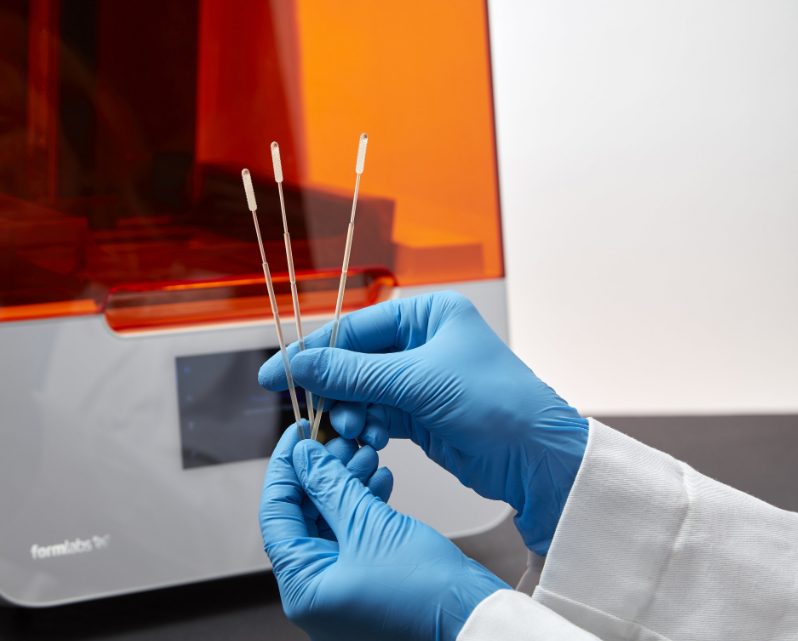
Desktop and benchtop SLA 3D printers have democratized access to professional-grade resin printing technology that was previously limited to expensive industrial systems costing over $100,000. Modern desktop SLA systems like the Formlabs Form 4 series now offer print volumes, accuracy, and material properties that rival industrial equipment at a fraction of the cost.
This guide covers how desktop SLA 3D printing works, the key advantages over other technologies, the range of available applications, and practical considerations for anyone evaluating resin printing for professional prototyping, manufacturing aids, or end-use production.
Modern SLA resins include flexible and elastic formulations that enable production of rubber-like parts for consumer prototyping and wearable applications
How Desktop SLA 3D Printing Works
Stereolithography uses a light source to cure liquid photopolymer resin into solid three-dimensional objects. The process works by exposing a vat of light-reactive resin to specific wavelengths of ultraviolet or visible light, which causes molecular chains to join together and polymerize the liquid into hardened plastic.
Modern desktop SLA printers use an inverted design where the light source is positioned below the resin vat rather than above it. This configuration, first introduced in 2011 by Formlabs, offers significant advantages in build volume, reliability, and ease of use compared to traditional top-down SLA systems.
In an inverted SLA printer, the build platform lowers into the resin vat and the light source projects the cross-section of each layer onto the bottom of the tank. The cured resin bonds to the platform and as each layer completes, the platform rises slightly to allow fresh resin to flow beneath the previously cured layer. This process repeats until the entire part is complete.
The light source in most modern desktop SLA printers uses LED arrays combined with LCD masking technology. This approach projects the entire layer shape simultaneously rather than tracing it with a laser, resulting in faster print times and lower equipment costs while maintaining high resolution.
Key Advantages of SLA 3D Printing Over FDM
Understanding the differences between SLA and FDM 3D printing helps determine which technology best suits a given application. While FDM excels in simplicity, material cost, and ease of use for basic prototyping, SLA delivers superior performance across several critical metrics.
Surface Quality and Detail Resolution
SLA produces parts with dramatically smoother surface finish because each layer is cured as a flat plane rather than being extruded as a rounded line. FDM layers are inherently visible as stepped ridges on curved surfaces, while SLA layers are nearly invisible even on detailed geometry.
The light projection approach in SLA also enables finer detail resolution. Desktop SLA printers commonly achieve layer heights of 25-50 microns (0.025-0.05mm), compared to typical FDM layer heights of 100-300 microns. This difference is particularly significant for jewelry patterns, dental restorations, and precision engineering prototypes.
Accuracy and Dimensional Stability
SLA parts exhibit superior dimensional accuracy and consistency across layers. The isotropic properties of SLA parts mean the material behaves consistently in all directions, unlike FDM parts which can exhibit anisotropic strength along layer lines.
SLA is particularly advantageous for functional prototypes that must fit precisely with other components. The accuracy and repeatability of SLA makes it suitable for creating mating parts, snap-fit assemblies, and functional components that would require extensive post-processing with FDM.
Material Properties
SLA resins span a broader range of functional properties than FDM filaments. While FDM materials are primarily limited to thermoplastics with moderate heat resistance and basic mechanical properties, SLA resins include engineering-grade materials with thermal resistance exceeding 200°C, flexible elastomers, biocompatible medical-grade materials, and castable formulations for investment casting.
The versatility of SLA resin formulations enables production of end-use parts with specific property requirements without the compromise inherent in general-purpose FDM materials.
SLA 3D Printing Applications
SLA applications span multiple industries and use cases where high resolution, smooth surface finish, and specific material properties are required. The technology has become essential in dental, medical, jewelry, engineering, and manufacturing sectors.
Dental and Medical Applications
The dental industry has adopted SLA as a standard production technology for restorations, surgical guides, and orthodontic appliances. The accuracy and biocompatible material options make SLA ideal for patient-specific medical devices and anatomical models for pre-surgical planning.
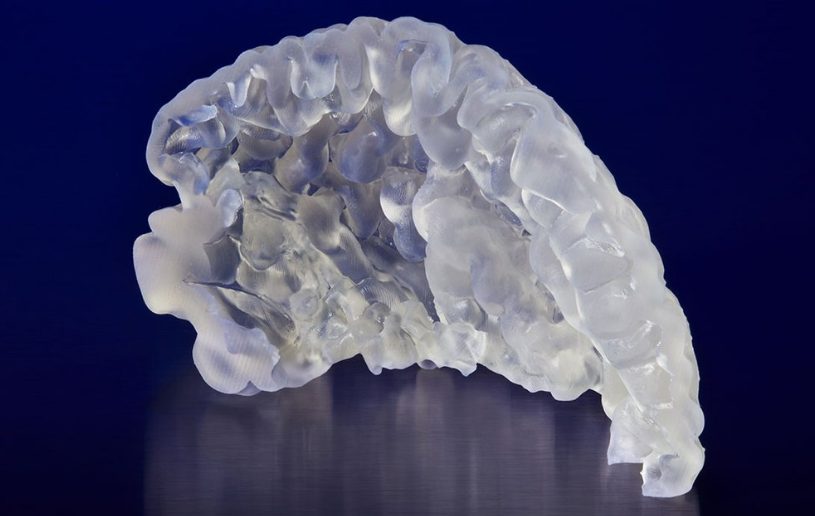
Medical researchers use SLA to create patient-specific anatomical phantoms that accurately replicate the imaging characteristics of human tissue. These phantoms enable calibration of diagnostic equipment and training of medical personnel without requiring access to actual patients or cadavers.
BioMed resins from Formlabs and similar materials are FDA-cleared for producing long-term implantable devices and surgical instruments. The ISO 13485 certified manufacturing environment ensures traceability and consistency required for medical device production.
Elastic resins achieve up to 150% elongation at break, making them suitable for soft tissue anatomical models and wearable device prototyping
Jewelry and Investment Casting
The jewelry industry uses SLA for pattern making prior to investment casting. Castable resins burn out cleanly without leaving residue, enabling creation of complex metal jewelry with intricate details that would be impossible to achieve through traditional wax carving.
SLA patterns for casting require minimal post-processing compared to wax, reducing labor costs and improving consistency. The digital workflow also enables direct adaptation of CAD designs for 3D printing without intermediate steps.
Engineering and Product Design
Engineering prototypes benefit from SLA’s accuracy, surface quality, and range of engineering-grade resins. Functional prototypes created in SLA can undergo testing for fit, form, and sometimes even limited production runs before committing to injection molding tooling.
Quick-turn prototypes created with high-temperature resins enable testing of parts that must withstand elevated temperatures during use or subsequent manufacturing processes like solder reflow. This capability is particularly valuable for electronics enclosures and automotive components.
Manufacturing Aids and Tooling
Manufacturing teams use SLA to produce jigs, fixtures, and custom tooling that improve production efficiency. The ability to quickly iterate and produce customized work aids without tooling costs makes SLA particularly valuable for low-volume production and custom manufacturing environments.
Flexible and elastic resins enable creation of ergonomic grips, protective covers, and vibration-dampening components that improve worker comfort and safety. These applications often replace purchased components with in-house 3D printed alternatives at lower cost and faster lead time.
Biocompatible SLA resins enable production of FDA-cleared medical devices, surgical planning tools, and patient-specific anatomical models
SLA Resin Materials Overview
The range of available SLA resin materials has expanded significantly as the technology matured. Understanding the different resin categories helps in selecting the appropriate material for specific applications.
Standard and Engineering Resins
Standard clear and colored resins provide excellent surface quality and accuracy for general-purpose prototyping and visual models. Engineering resins add improved mechanical properties including higher heat deflection temperature, impact resistance, and tensile strength for functional testing.
Rigid resins with glass-filled compositions offer stiffness and thermal stability comparable to engineering plastics. These materials are suitable for structural components, housings, and parts requiring dimensional stability under load or elevated temperature.
Flexible and Elastic Resins
Flexible resins like Flexible 80A and Elastic 50A enable production of rubber-like parts on SLA printers. These materials are particularly valuable for creating functional prototypes of wearable devices, grips, seals, and soft-touch components without requiring expensive multi-material equipment.
The flexibility range spans from soft silicones to firm rubbers, enabling selection of appropriate durometer for specific functional requirements. Some formulations achieve up to 150% elongation at break while maintaining sufficient strength for repeated use.
Castable and Jewelers Resins
Castable resins are formulated to burn out completely during investment casting, leaving no residue that could affect metal quality. These resins enable complex jewelry designs and dental restorations that would be impractical to produce through traditional methods.
Castable resins require specific handling procedures to ensure complete burnout. Following manufacturer guidelines for burnout cycle temperature and duration is essential to avoid casting defects from residual carbon or ash.
SLA Post-Processing Requirements
SLA printing requires post-processing steps that FDM typically does not need. Understanding these requirements ensures proper workflow design and avoids quality issues with finished parts.
Washing and Solvent Cleaning
Immediately after printing, SLA parts retain excess uncured resin on their surfaces that must be removed through washing. Isopropyl alcohol (IPA) or proprietary cleaning solutions are used to dissolve and remove this excess material.
Insufficient washing leaves a tacky surface residue that affects appearance and can continue to cure over time. Excessive washing or soaking can damage fine features or cause dimensional changes in some resin formulations. Following manufacturer recommendations for wash time and solvent choice is important for consistent results.
Post-Cure and Thermal Processing
Most SLA resins require additional UV exposure after washing to complete the polymerization process and achieve optimal material properties. Post-curing units provide controlled UV exposure and often include heating to accelerate the final cure.
Some engineering and flexible resins benefit from thermal post-curing in addition to UV exposure. The elevated temperature helps the material reach its maximum glass transition temperature and ensures complete polymerization throughout thick sections.
Choosing Between SLA and FDM
Selecting the appropriate technology depends on specific application requirements, budget, and production volume. Both SLA and FDM have legitimate use cases where each excels.
FDM remains advantageous for large parts where surface finish is less critical, for high-volume production where material cost dominates, and for environments where resin handling and post-processing workflow complexity is prohibitive. FDM also offers a wider range of high-performance engineering thermoplastics including PEKK, PEI (ULTEM), and carbon fiber-reinforced composites.
SLA is the clear choice when surface quality, fine detail, dimensional accuracy, or specific material properties like biocompatibility or castability are required. The lower equipment cost of modern desktop systems has made SLA accessible for small teams and individual practitioners who previously could not justify industrial SLA equipment.
Conclusion
Desktop SLA 3D printing offers capabilities that complement and in some cases replace FDM technology for professional prototyping and limited production. The exceptional surface quality, accuracy, and range of available materials make SLA particularly valuable for dental, medical, jewelry, and engineering applications where part quality directly impacts outcomes.
The decreasing cost of desktop SLA equipment has made high-resolution resin printing accessible beyond large organizations with dedicated additive manufacturing facilities. Small design teams, dental labs, and independent jewelers can now produce parts that previously required industrial equipment and substantial capital investment.
Understanding the post-processing requirements and material handling procedures for SLA is essential for achieving consistent, high-quality results. The additional workflow steps are manageable with proper training and equipment, and the quality advantages often justify the extra effort for applications where surface finish and accuracy matter.
Thank you for signing up. You will be the first to know the Industry news, upcoming products, latest technology and special promotion.